What distinguishes software engineering from programming?
covers: lo-1
Answer
Two things that are absent when you program alone for an afternoon: other people and time.
| Programming | Software engineering |
|---|---|
it works on my machine, today |
it works on other machines, next year |
I understand my code |
somebody who has never met me can change it safely |
I remember why I did that |
the reason survives me leaving |
one person, one session |
a team, many sessions, changing membership |
Programming is getting a machine to do something. Everything that becomes necessary once the result has to survive contact with colleagues and with next year is engineering — and that is not a moral upgrade, it is a different problem.
The whole subject follows from this difference. Version control exists because several people touch the same lines. Specifications exist because intent has to outlive a conversation. Reviews exist because nobody catches their own mistakes. CI exists because "it worked when I checked" is not a claim anybody else can verify. Each practice in this course can be traced back to one of the two words: people, or time.
Points the answer must contain:
-
Other people and time
-
Works elsewhere and later; changeable by someone who never met the author
-
The reasons survive the author leaving
Name the forces that make software hard, with one example each
covers: lo-2
Answer
| Force | Example from a school project |
|---|---|
Change — requirements move while you build |
the feature agreed in October is wrong in February; the specs move visibly, the charter does not |
Scale — more code, more people, more state |
the file everyone edits becomes the file nobody dares to touch |
Time — the system outlives its authors |
a project handed over in year five to somebody who was not there |
Communication — most defects start as misunderstandings |
"done" meaning two different things to two people |
Uncertainty — you cannot know before you build |
estimates that were honest and still wrong |
Not one of these is a technical problem, and this is the observation the whole subject rests on. A faster language does not stop requirements from moving. A better framework does not make "done" mean the same thing to two people. They are answered by practices — and a practice that cannot name the force it answers is a ritual, which is why this course drops such practices rather than teaching them.
Points the answer must contain:
-
Change, scale, time, communication, uncertainty
-
Examples from a school project: requirements moving mid-year, the file nobody dares to touch, handover in year five, "done" meaning two things
-
None is solved by a better language
Which practice answers which force? Give two pairs
covers: lo-2
Answer
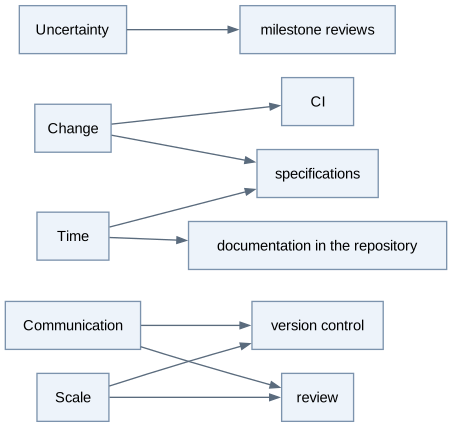
Version control and reviews answer communication and scale. Several people change the same lines, and the history plus the review is what keeps that from becoming guesswork about who meant what.
Specifications answer change and time. A written specification is the intent in a form that survives both the conversation it came from and the person who had it — so a requirement that moves can be seen to have moved.
CI answers verification under change. "It worked when I checked" is not verifiable by anybody else; a pipeline turns it into a statement with a date, a commit and a result attached.
Any two of these pairs are a complete answer, as long as you can name the force and say why the practice addresses that force rather than a different one.
Points the answer must contain:
-
Version control and reviews answer communication and scale
-
Specifications answer change and time
-
CI answers "it worked when I checked" — verification under change
What did cheap code production change, and what did it not?
covers: lo-3
Answer
| Changed | Unchanged |
|---|---|
writing an implementation is fast and cheap |
deciding what should be true is still yours |
explanations are available on demand |
knowing which explanation applies here is not |
a first version appears in minutes |
integrating, verifying and maintaining it takes what it took |
the bottleneck moved |
the bottleneck exists |
The short form: producing got cheap, deciding and verifying did not. An agent will write the export service in a minute; it cannot tell you whether the class teachers need CSV or XLSX, whether a booking that has already started may be cancelled, or whether the thing it produced actually does what the charter promised.
This is why the year spends its time on governance, specification and verification rather than on typing. The part that got cheaper was never the hard part — it was the visible part, which is not the same thing.
Points the answer must contain:
-
Implementation became fast; deciding what should be true did not
-
Integration, verification and maintenance cost what they cost
-
The bottleneck moved to specifying and verifying
Why is "engineering is obsolete now" the wrong conclusion?
covers: lo-3
Answer
Because it reverses the arithmetic. When one step in a chain becomes almost free, the remaining steps do not become less important — they become all of the effort. Cheap production means more code arrives, faster, from a source that does not know your context, so deciding what should be true and checking that it is true now dominate the work instead of sharing it with typing.
The practical evidence is visible within a week of using an agent seriously: the implementation is done in minutes and the day still goes on reviewing, integrating, correcting the specification that turned out to be ambiguous, and finding the case the agent silently assumed. Those are engineering activities, and there is now more of them per hour, not less.
The expensive parts were never the typing. They were agreeing on what to build, keeping the reasons available to the next person, and being able to show that the result works.
Points the answer must contain:
-
When producing is cheap, deciding and verifying dominate the effort
-
The expensive parts were never the typing