Why does a requirements document go stale, and why does a target state not?
covers: lo-1
Answer
Three properties of the classical document, none of them anybody’s fault:
-
Finished before the work begins. Everything learned afterwards — from the first user, the first prototype, the first impossibility — has nowhere to go.
-
Expensive to update. A re-agreed, re-signed document costs a meeting, so the small corrections are skipped, and small corrections are most of them.
-
Not used. Nobody reads it while working, so nobody notices it is wrong. A document read daily cannot rot; one opened twice can.
The target state reverses all three. It is written continuously with the work, updated by archiving a change — which costs no more than doing the work — and read before every change by everybody.
The consequence is the substantial one: when the classical document disagrees with the code, the document is simply wrong, and the drift is total by March. When the target state disagrees with the system, it is a finding — either a bug or a spec defect — and it gets fixed.
Points the answer must contain:
-
Written once, expensive to update, not read while working
-
The target state is written with the work and updated by archiving
-
Divergence is a finding, not a normal condition
-
Being read often is what makes divergence noticeable at all
If the target state may change, what stops a team from redefining success?
covers: lo-2
Answer
The charter, which stays frozen.
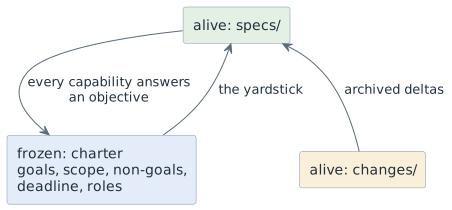
Two things stay fixed, and they are the ones with somebody else’s name on them: the charter — objectives, scope, non-goals, deadline, roles — and the acceptance criteria derived from it. Changing the charter is possible and sometimes right, but it is a written negotiation, never a side effect of a change.
If the acceptance criteria moved with the work, the project could not fail — and a project that cannot fail is not being assessed. The target state may say more than the charter and say it more precisely; it may not say something else.
Points the answer must contain:
-
The charter and the acceptance criteria derived from it stay frozen
-
Changing the charter is an explicit written negotiation
-
Every capability must answer some charter objective
-
Movable criteria make the project unfailable, hence unassessable
Trace one requirement from elicitation to verification.
covers: lo-3
Answer
| Stage | Wording |
|---|---|
elicited |
a sign-in sheet with an |
Lastenheft |
"attendance must be recorded per member and session, including excused absence" |
charter objective |
"trainers record attendance digitally, including excused absence" |
target state |
|
change |
|
archived |
delta in |
verified |
the scenario is run at the milestone review |
Two things to notice. The vocabulary is stable the whole way down — "excused" appears at every stage because it came from the client’s own document, which is what the glossary in the elicitation module was for. And the wording gets more precise without getting bigger: the target state names three states, which nobody said out loud but the sheet implied.
Points the answer must contain:
-
Document/interview → Lastenheft → charter objective → specs → change → archive → scenario run
-
The client’s vocabulary survives unchanged through all of it
-
Precision increases; scope does not
-
Verification is running a scenario, not comparing texts
Where does a given sentence belong — charter, target state or change?
covers: lo-4
Answer
| Sentence | Belongs |
|---|---|
"usable by trainers who are not technical" |
charter — an objective, not a checkable behaviour |
"attendance for a past session cannot be changed" |
target state — a behaviour that must be true now |
"we will add the export in November" |
a change — an intention with a date; not a requirement at all |
"we deliberately do not build a mobile app" |
charter, as a non-goal — the entry that saves the most argument later |
"the list is sorted by surname" |
target state if a user can observe it; nowhere if it is an implementation detail |
The test in one question: who would notice if this were false? The client notices a broken objective; a user notices a wrong behaviour; only the team notices an unmet intention. Things only the team notices belong in neither document.
The last row is the one worth arguing about in class, because it depends on something outside the sentence — whether the ordering is visible to a user.
Points the answer must contain:
-
Charter = objectives, scope, non-goals; target state = current required behaviour; change = intention
-
The test: who would notice if it were false?
-
Non-goals belong in the charter and are worth writing
-
Implementation details belong in neither
What replaces the signed requirements document at acceptance?
covers: lo-5
Answer
Running the target state in front of the client.
-
Every charter objective maps to capabilities in
specs/. -
Every capability has scenarios.
-
The scenarios are executed in the room, and either pass or do not.
-
The archive shows when each became true.
This is stronger than a signature, for one reason: it is falsifiable on the spot. A signed document records that two parties once agreed on a text; a scenario that runs shows that the software does the thing. The classical model compares two documents and hopes the second describes the first.
It also removes the standard acceptance argument — "that is not what we meant" — because the scenario was written in the client’s vocabulary and has been visible in the repository since the change that introduced it.
Points the answer must contain:
-
Objectives → capabilities → scenarios, executed with the client present
-
Falsifiable in the room; a signature is not
-
The archive dates when each behaviour became true
-
The client’s own vocabulary was used throughout, so the scenarios are readable
Why must a Pflichtenheft and a target state not be maintained side by side?
covers: lo-1, lo-4
Answer
Because two descriptions of the same thing become two different descriptions within about a month, and then neither can be trusted.
The mechanism is the one already known from the delta and the target state: a fact that lives in one place is either right or wrong; a fact that lives in two places is right in one of them and nobody knows which. Only one copy gets updated when the requirement changes, and it is always the one the team actually uses. The other keeps its authority — it is the one with the signature — while quietly becoming fiction.
The practical resolution is not to abolish the Pflichtenheft where a client requires one. It is to generate or derive it from the target state at the moment it is needed, so there is still only one source. What must not happen is two documents both maintained by hand.
Points the answer must contain:
-
Two copies of a fact drift; the unused one keeps its authority
-
The team updates the one it works with, which is not the signed one
-
Same one-fact-in-one-place rule as target state versus delta
-
Where a Pflichtenheft is required, derive it from the target state