Learning outcomes
-
Explain why a requirements document goes stale and a target state does not
-
Name what must stay frozen even when the target state lives, and why
-
Trace a requirement from the Lastenheft through to an archived change
-
Decide whether a proposed wording belongs in the charter, the target state or a change
-
Explain what replaces the signed requirements document at acceptance
The document that is wrong by March
The classical shape: a Pflichtenheft is written, agreed, signed, and printed. Then the project starts, and every week the software and the document drift a little further apart.
Nobody decides to let that happen. It follows from three properties of the artefact:
-
It is finished before the work begins. Everything anybody learns afterwards — from the first user, the first prototype, the first thing that turned out impossible — has nowhere to go.
-
Updating it is expensive. A re-agreed, re-signed document costs a meeting, so small corrections are not made, and the small ones are most of them.
-
It is not used. Nobody reads it while working, so nobody notices it is wrong. A document that is checked daily cannot rot; one that is opened twice can.
By March the honest description of the system is in the code, and the code cannot be read by the client.
What changes when the target state is alive
openspec/specs/ is the same content with three properties reversed.
| Requirements document | Living target state | |
|---|---|---|
Written |
once, before the work |
continuously, with the work |
Updated by |
a meeting and a signature |
an archived change |
Read |
at the start and at the end |
before every change, by everybody |
Says |
what was agreed then |
what must be true now |
When it disagrees with the code |
the document is wrong |
one of them is a defect, and you must find out which |
The last row is the substantial one. In the classical model a divergence between document and code is normal and eventually total. Here it is a finding: either the code fails to do what the target state says — a bug — or the target state claims something nobody wanted — a spec defect. Both are actionable, and both get fixed. That is only possible because the target state is cheap to change and is read often enough for the divergence to be noticed.
The mechanism that makes it cheap is the one from sdd-change-lifecycle:
specs/ is only ever modified by archiving a change, so an update costs the same
as doing the work, and no more.
What still has to be frozen
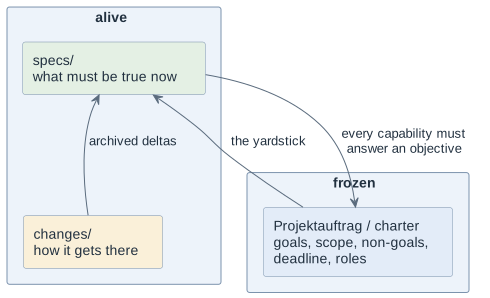
A living target state is not a licence to redefine the project in April. Two things stay fixed, and they are the ones with somebody else’s name on them:
-
The charter — objectives, scope, non-goals, deadline, responsibilities. It is the agreement with the client and the yardstick the project is measured against. Changing it is possible and sometimes right, but it is a negotiation, in writing, not a side effect of a change.
-
The acceptance criteria derived from it. If those move with the work, the project can never fail, and a project that cannot fail is not being assessed.
The two together answer the obvious objection to living specifications: if the target moves, what stops the team from redefining success? The charter does. The target state may say more than the charter, and it may say it more precisely, but every capability in it has to answer some objective of the charter — and a capability that answers none is either scope creep or a charter that needs renegotiating in the open.
One requirement, all the way through
The chain is worth walking once end to end, because each link belongs to a different lesson and they are easy to see as separate topics.
| Stage | Artefact and wording |
|---|---|
elicited |
a sign-in sheet with an |
Lastenheft |
"attendance must be recorded per member and session, including excused absence" |
charter objective |
"trainers record attendance digitally, including excused absence" |
target state |
|
change |
|
archived |
the delta is in |
verified |
a scenario from |
Two observations about that table. The vocabulary is stable all the way down — excused appears at every stage, because it came from the client’s own document, which is why the glossary was built in the elicitation module. And the wording gets more precise without getting bigger: the target state adds the three states, which nobody said out loud but the sheet implied.
Where does this sentence belong?
The everyday decision, and it has a short test.
| Sentence | Belongs |
|---|---|
"The system must be usable by trainers who are not technical." |
charter — a project objective, not a checkable behaviour |
"Attendance for a past session cannot be changed." |
target state — a behaviour that must be true now |
"We will add the export in November." |
a change — an intention with a date, which is not a requirement at all |
"We deliberately do not build a mobile app." |
charter, as a non-goal — and it is the entry that saves the most argument later |
"The list is sorted by surname." |
target state, if a user can observe it; nowhere, if it is an implementation detail |
The test in one question: who would notice if this were false? The client notices a broken objective. A user notices a wrong behaviour. Only the team notices an unmet intention — and things only the team notices do not belong in either document.
What replaces the signature
At acceptance the classical model produces a document comparison: does the delivered system match the signed Pflichtenheft? Here the same question is answered by running the target state.
-
Every charter objective maps to capabilities in
specs/. -
Every capability has scenarios.
-
Scenarios are executed, in front of the client, and either pass or do not.
-
The archive shows when each became true.
That is a stronger form of acceptance than a signature on a document, for a simple reason: it is falsifiable in the room. A signed document says two parties once agreed on a text. A scenario that runs says the software does the thing.
The details of the handover — what is signed, what is delivered, what the client
must be able to do afterwards — are the subject of governance-acceptance.
Decisions
-
specs/is the authoritative description of intended behaviour. No separate requirements document is maintained alongside it. -
The charter stays frozen. Changing it is a written negotiation with the client, never a side effect of a change.
-
Every capability in
specs/must be traceable to a charter objective. One that is not is raised at the next milestone. -
A divergence between
specs/and the running system is a finding, and it is resolved in one direction or the other — never left standing. -
Acceptance is performed by running scenarios, not by comparing documents.
Pitfalls
-
Maintaining a Pflichtenheft and a target state. Two descriptions of the same thing, and within a month one of them is lying.
-
Treating "living" as "negotiable". The charter is the anchor; without it the project cannot fail and therefore cannot succeed.
-
Capabilities that answer no objective. That is scope creep with good documentation.
-
Leaving a known divergence between spec and system because "everyone knows". Nobody knows in June.
-
Writing intentions into
specs/— "we will add …". The target state is present tense. -
Adjusting acceptance criteria to what was built. The project then measures its own output against itself.
Terminology
| Deutsch | English |
|---|---|
Lastenheft |
requirements specification (client’s) |
Pflichtenheft |
functional specification (contractor’s) |
Zielzustand |
target state |
eingefroren |
frozen |
Nachverfolgbarkeit |
traceability |
Abnahmekriterium |
acceptance criterion |
Nichtziel |
non-goal |
Abweichung |
divergence |
Further reading
-
Module
sdd-why-specs— the first pass at the same question, with the DIN structure of the Pflichtenheft -
Module
sdd-change-lifecycle— why an update to the target state is cheap -
Module
governance-acceptance— what happens at the handover