Which artefacts does a change carry, and what does each answer?
covers: lo-1
Answer
Four, and each one answers a different question:
| Artefact | Question | Fails when |
|---|---|---|
|
why now, what changes, which capabilities |
it lists activities instead of a reason |
|
what must be true afterwards |
it describes the implementation |
|
which decision, which rejected alternatives, why |
it exists although nothing was decided |
|
which steps, in which order, verified how |
a task cannot say whether it is done |
They are deliberately separate because they answer to different readers and change at different moments. The proposal is read once, when the change is approved. The spec outlives the change entirely — it folds into the target state. The design is read years later by somebody about to repeat a rejected idea. The tasks are read daily and then never again.
What is not among them is as telling: no status report, no percentage, no time sheet. The artefacts are the report.
Points the answer must contain:
-
proposal, spec delta, design (conditional), tasks
-
One question per artefact, and the characteristic failure of each
-
No separate status reporting — the artefacts carry the progress
What is the difference between the target state and the delta?
covers: lo-2
Answer
Tense and lifetime.
openspec/specs/ is the target state: present tense, describing the system as
it is meant to be now. openspec/changes/<id>/ is a delta: one intention,
describing what shall become true. Archiving folds the delta into the target
state and moves the change into changes/archive/.
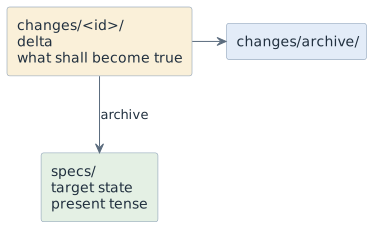
The point of the split is that a fact lives in exactly one place. Documentation goes stale when the same statement exists twice and only one copy gets updated; here there is nothing to keep in sync.
The test when you cannot decide: would this sentence still be true in a year? If yes, target state. If it only makes sense while the work is happening, it is part of the change.
Points the answer must contain:
-
specs/ = target state, present tense, what is true now
-
changes/ = delta, one intention, what shall become true
-
Archiving folds the delta in; the archive carries the history
-
One fact in one place — that is what prevents stale documentation
Write a requirement with a scenario, and say what makes it checkable.
covers: lo-3
Answer
### Requirement: A full session refuses further bookings

The system SHALL refuse a booking when the session has reached its capacity,
and SHALL state the reason to the caller.

#### Scenario: booking the twenty-first place
- **GIVEN** a session with capacity 20 and 20 confirmed bookings
- **WHEN** a member books that session
- **THEN** the booking is refused
- **AND** the response names the reason "session full"
Three properties make it checkable. It says what, never how — no table, no class, no framework appears, so it survives a rewrite of the implementation. Every value is observable from outside: capacity, a refusal, a reason string. And it is falsifiable — you can state exactly what would prove it wrong.
SHALL marks the sentence as binding rather than aspirational; it is the same
vocabulary the client’s Pflichtenheft uses.
Scenarios come roughly in threes: the normal case, the boundary, and the case that must be refused. A spec with only the happy path is the commonest defect in student work — the refusals are where the requirements actually are.
Points the answer must contain:
-
Requirement states the behaviour, scenario makes it checkable
-
GIVEN/WHEN/THEN with observable values
-
What, not how — no implementation vocabulary
-
Normal case, boundary, refusal — not only the happy path
When does a change need a design document?
covers: lo-4
Answer
When there was a choice. That is the whole test.
| Needs one | Does not |
|---|---|
two storage options, one picked |
adding a field to an existing form |
a new dependency enters the project |
renaming a method |
the data model changes shape |
fixing an off-by-one |
something is deliberately not done |
a change with one sensible implementation |
It must contain the decision, the alternatives that were seriously considered, and why they were rejected. The rejected options are the part with the long shelf life: in six months somebody proposes one of them again, and the document is the difference between a five-minute answer and the same argument a second time.
Both failure directions cost. Skipping it when a decision was made loses the reasoning permanently — nobody reconstructs it from the code. Writing one for a change that decided nothing produces pages nobody reads, and that habit is exactly why the necessary one later gets skipped too.
Points the answer must contain:
-
The test: was there a real choice between reasonable options?
-
Contents: decision, alternatives considered, reasons for rejection
-
Rejected alternatives are the durable value
-
Both skipping and writing it by default are failures
What must a task contain to be usable?
covers: lo-5
Answer
A statement of how it is verified. A task without a check is a wish, and a list of wishes cannot tell anybody whether the change is finished.
| Unusable | Usable |
|---|---|
"Implement booking" |
“BookingService.book()` refuses a full session; verified by `BookingServiceTest.refusesWhenFull” |
"Fix the tests" |
"`./gradlew test` is green" |
"Documentation" |
"`README` names the new endpoint; |
Tasks phrased as topics — "Testing", "Frontend" — can never be honestly ticked off, which is why a task list of topics always ends the term at eighty per cent.
Order carries information too: it is the only place the sequence of the work is recorded. If task 7 cannot begin before task 3 finishes, that has to be visible, or two people will start it at the same time.
The audience is the reason for all of it: tasks are written for somebody else, including yourself in three weeks, who will have forgotten the context entirely.
Points the answer must contain:
-
Every task names its verification; without one it is a wish
-
Concrete deliverable, not a topic heading
-
The order records the dependencies between steps
-
Written for another reader, not as a private note
Why is the proposal separate from the specification?
covers: lo-1, lo-2
Answer
Because they have different lifetimes and different readers.
The proposal answers why now — the problem in the words of somebody who is not on the team, the boundary of the change, and the capabilities it touches. It is read once, when the change is approved, and then it is history.
The specification answers what must be true afterwards, and it is the part that survives: on archiving it folds into the target state and stays there long after the change is forgotten. It contains no justification at all — a target state does not argue for itself.
Merging them produces the usual student artefact: a document that explains and
specifies at once, and can therefore be neither reviewed for its reasoning nor
folded into specs/ without carrying the reasoning along. The reason is dated;
the requirement is not.
The characteristic failure of a proposal is worth stating separately: if every sentence begins with "we will", it is a to-do list and the reason has not been written yet.
Points the answer must contain:
-
Proposal = why now, boundary, capabilities; read once
-
Specification = what must be true; folds into the target state and stays
-
Different lifetimes, so keeping them apart keeps the target state clean
-
"We will …" throughout means the reason is missing