Learning outcomes
Two folders, two tenses
openspec-hands-on walked the loop with the tooling. This lesson looks at what
that loop leaves behind, because the artefacts — not the commands — are what the
project is assessed on.
Everything rests on one distinction:
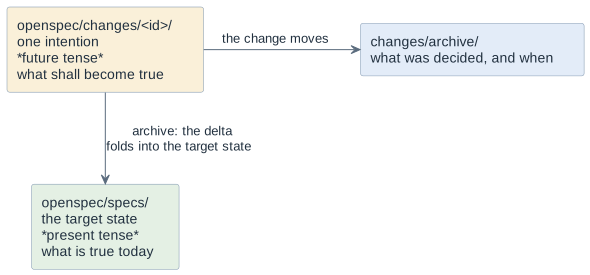
specs/ is written in the present tense and describes the system as it is meant
to be now. changes/ is written per intention and describes a delta: what
this one change adds, alters or removes. The two never say the same thing twice —
which is the property that keeps the documentation from going stale, because
there is only one place a fact can live.
A useful test when you cannot decide where something goes: would this sentence still be true in a year? If yes, it is target state. If it only makes sense while the work is being done, it belongs to the change.
The four artefacts
| Artefact | The question it answers | It has failed when |
|---|---|---|
|
Why now? What changes? Which capabilities does it touch? |
it lists activities ("we will write a service") instead of a reason |
|
What must be true afterwards? |
it describes the implementation instead of the behaviour |
|
Which decision was taken, which alternatives were rejected, and why? |
it exists although no choice was ever made |
|
Which steps, in which order, and how is each one verified? |
a task cannot tell you whether it is done |
Note what is not in the list: a status report, a time sheet, a progress
percentage. The artefacts are the report — that is the subject of
bridge-progress-and-milestones.
The proposal
Three paragraphs, not three pages. The one that matters is the first:
-
Why now — the problem, in terms of somebody who is not on the team. "Trainers cannot see who paid" beats "we need a payment module".
-
What changes — the boundary of this change, stated so a reviewer can tell what is outside it.
-
Which capabilities — which parts of the target state this change touches.
The characteristic failure is a proposal that is a to-do list in prose. If every sentence starts with "we will", the reason has not been written yet.
The specification: requirement and scenario
A requirement states a behaviour. A scenario makes it checkable. Neither works alone: a requirement without a scenario is an opinion, a scenario without a requirement is a test with no stated purpose.
### Requirement: A full session refuses further bookings

The system SHALL refuse a booking when the session has reached its capacity,
and SHALL state the reason to the caller.

#### Scenario: booking the twenty-first place
- **GIVEN** a session with capacity 20 and 20 confirmed bookings
- **WHEN** a member books that session
- **THEN** the booking is refused
- **AND** the response names the reason "session full"
Three properties of that block are worth naming, because they are what separates a specification from a wish:
-
it says what, never how — no table, no class, no framework appears;
-
every value in it is observable from outside the system;
-
it is falsifiable: you can write down exactly what would prove it wrong.
The keyword SHALL is not decoration. It marks the sentence as binding, and it
is the vocabulary the client’s own documents already use — the Pflichtenheft
of sdd-why-specs is built from the same kind of sentence.
Scenarios come in threes, roughly: the normal case, the boundary, and the case that must be refused. A specification with only the happy path is the single most common defect in student work, and it is also the one that costs the most in June — the refusals are where the interesting bugs live.
The design document
The one artefact people either skip when they needed it or write when they did not. The test is one question: was there a choice?
| Needs a design document | Does not |
|---|---|
Two storage options, one picked |
Adding a field to an existing form |
A new dependency enters the project |
Renaming a method |
The data model changes shape |
Fixing an off-by-one |
Something is deliberately not done |
A change with exactly one sensible implementation |
What it must contain: the decision, the alternatives that were seriously considered, and why they were rejected. The rejected options are the valuable part — six months later somebody will propose one of them again, and the document is the difference between a five-minute answer and a repeated argument.
A design document is not a UML gallery. Diagrams appear where they carry the argument, not to fill the page.
The task list
Tasks are for somebody else — including yourself in three weeks, who will have forgotten everything.
| Unusable | Usable |
|---|---|
"Implement booking" |
“BookingService.book()` refuses a full session; verified by `BookingServiceTest.refusesWhenFull” |
"Fix the tests" |
"`./gradlew test` is green" |
"Documentation" |
"`README` names the new endpoint; |
Every task names how it is verified. A task without a check is a wish, and a list of wishes cannot tell anybody whether the change is finished.
Order matters too, and for a reason that is easy to miss: the order of the tasks is the only place where the sequence of the work is recorded. If task 7 cannot start before task 3, that has to be visible, or two people will collide.
Decisions
-
Every change carries
proposal.md, its spec delta andtasks.md.design.mdis written when a decision was taken. -
Specifications are written before tasks. Planning work whose target is not yet decided is how scope drifts.
-
Every requirement has at least one scenario, and every scenario names an observable result.
-
Each capability gets at least one refusal scenario, not only the happy path.
-
Every task states its verification. A task without one does not go on the list.
-
specs/is present tense and holds no history; the history is the archive.
Pitfalls
-
Writing the specification in terms of tables, classes or endpoints. That is design leaking into the target state, and it makes the spec obsolete the first time the implementation changes.
-
Only happy-path scenarios. The refusals carry the actual requirements.
-
A proposal that lists activities. Nobody can review a change whose reason is missing.
-
A design document for a change that had no decision — pages nobody reads, and the habit that then makes people skip the one that mattered.
-
Copying target-state text into the change, or the reverse. Two copies of a fact drift apart, and neither is then trustworthy.
-
Tasks phrased as topics ("Testing", "Frontend"). They can never be ticked off honestly.
Terminology
| Deutsch | English |
|---|---|
Zielzustand |
target state |
Änderungsdelta |
delta |
Vorschlag, Begründung |
proposal |
Anforderung |
requirement |
Szenario |
scenario |
Entwurfsentscheidung |
design decision |
verworfene Alternative |
rejected alternative |
Aufgabenliste |
task list |
Abnahmekriterium |
acceptance criterion |
Further reading
-
This repository’s
openspec/specs/andopenspec/changes/— a worked example -
Module
sdd-why-specs— why a living target state instead of a requirements document, and where Lastenheft and Pflichtenheft fit -
Module
sdd-change-lifecycle— the same artefacts along their life cycle