Name the states of a change and the condition for each transition.
covers: lo-1
Answer
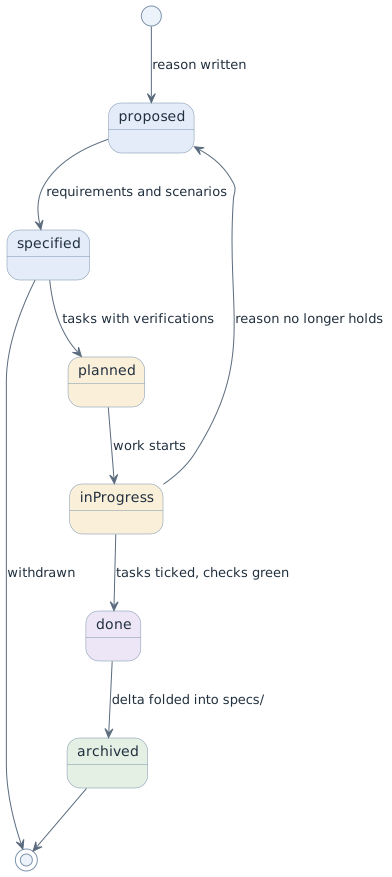
The condition on each arrow is what makes the state observable. "We are working on it" is not a state; specified is, because there is a document to point at. That is what turns a milestone review into a five-minute conversation instead of an interrogation.
The two backward arrows are not exceptions. A change may return to proposed when its reason stops holding, and it may be withdrawn outright — both are normal and both beat a change quietly abandoned in place.
Points the answer must contain:
-
proposed, specified, planned, in progress, done, archived
-
Each transition has a condition that can be pointed at
-
Backward transitions exist: return to proposed, withdrawal
-
A state is what the artefacts show, not what somebody reports
What does archiving do, and why is it the point of the loop?
covers: lo-2
Answer
Archiving folds the change’s delta into openspec/specs/ and moves the change
itself into changes/archive/. It is the only transition that changes anything
outside the change.
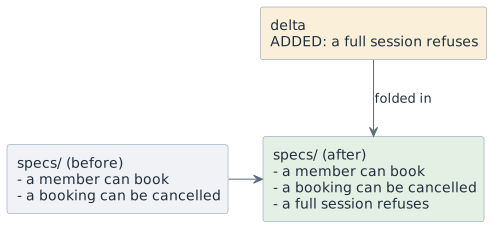
Three consequences:
-
The target state grows but carries no history —
specs/says what is true, the archive says how it got there. -
The archive is dated evidence. "Archived on 14 November, tasks ticked" is a fact; "we worked on booking" is not.
-
Nothing is written twice. The requirement moved; a fact in two places soon becomes a fact in two versions.
The commonest failure is the finished change that was never archived: the code exists, and the target state still describes a system that does not.
Points the answer must contain:
-
Delta folds into specs/, change moves to archive/
-
Target state grows and stays history-free
-
The archive is dated evidence of finished work
-
Unarchived finished work is invisible work
A change turns out to be wrong. What do you do?
covers: lo-3
Answer
Depends which part was wrong.
| Situation | Response |
|---|---|
the reason no longer holds |
withdraw it — into the archive, marked withdrawn, one sentence why |
the requirement was wrong but something is needed |
back to proposed; rewrite the spec delta, then re-plan |
the implementation was wrong, requirement stands |
stay in progress — an ordinary bug, not a life-cycle event |
Withdrawal is the one teams avoid because it feels like admitting failure. It is the opposite: it is a documented decision, and the undocumented ones are the expensive kind. Six months later "why is there no statistics page?" has an answer instead of a shrug.
What never helps is leaving it open. A change untouched for six weeks is not in progress — it is an unwritten decision, and at the review it counts as nothing either way. Writing it down costs nothing and buys clarity.
Points the answer must contain:
-
Distinguish wrong reason, wrong requirement, wrong implementation
-
Withdraw in writing; back to proposed; or just fix the bug
-
Withdrawal is a decision, not a failure
-
Leaving it open is the only response that helps nobody
Along which line do you split a change that is too large?
covers: lo-4
Answer
Along a line where each half can be archived alone.
| Good | Bad |
|---|---|
by capability — booking, then attendance |
by layer — backend change, then frontend change |
by scenario — happy path, then refusals |
by person — Marco’s part, Lisa’s part |
by risk — the decided part now, the open question later |
by time — week one, week two |
The right column shares one defect. A backend-only change leaves the target state
describing behaviour no user can reach; a change cut by person leaves a record
that describes the team rather than the system. Neither half is a coherent
statement about the system, so neither can fold into specs/.
The signal that a split is due: the task list is thirty items long and the first ten have nothing to do with the last ten. Splitting early is cheap; unpicking a half-finished change is not.
Points the answer must contain:
-
One intention, reviewable in one sitting, archivable as a whole
-
Split by capability, scenario or risk
-
Never by layer, person or calendar — those halves cannot be archived alone
-
The thirty-item unrelated task list is the warning sign
What can you read off a project’s changes/ and archive/ folders?
covers: lo-5
Answer
Most of what a milestone review needs, in about two minutes.
| What you see | What it means |
|---|---|
|
nothing finished — possibly much done |
twelve changes open, none archived |
no change was ever cut to a reviewable size |
|
deltas are not being folded in — the process is performed, not used |
one open, several archived, tasks ticked with dates |
the healthy picture |
everything archived in one burst last week |
the record was reconstructed; it is a story, not evidence |
The last row deserves its own sentence. A record written in June, dated June, describing work from November tells the reader exactly one thing: the process was not used. The dates are the evidence and they cannot be back-filled honestly — which is also why reconstructing turns an assessment of the work into a question about honesty.
Points the answer must contain:
-
Empty archive = nothing finished; many open changes = never split
-
Full archive with thin specs = deltas not folded in
-
Healthy: few open, several archived, dated ticks
-
Dates expose a reconstructed record
Why must specs/ never be edited directly?
covers: lo-2, lo-1
Answer
Because then the target state has an origin nobody can trace.
Every sentence in specs/ arrived there through an archived change, which
carries the reason it was made, the alternatives that were rejected and the date.
A sentence edited in directly has none of that: it is a requirement with no
author, no justification and no moment. The next person to disagree with it has
nothing to read.
It also breaks the one-fact-in-one-place property. A direct edit is not reconcilable with any delta, so if a change is later archived that touches the same capability, two statements about the same behaviour meet with no way to decide which is current.
The rule generalises beyond specs: the target state is derived from the history of changes. Anything that lets it drift from that history destroys the reason for having both.
Points the answer must contain:
-
Every sentence in specs/ arrives through an archived change
-
A direct edit has no reason, no alternatives, no date
-
It breaks reconciliation with later deltas
-
The target state must stay derivable from the archive