How does the second review differ from the first?
covers: lo-1
Answer
| Review 1 | Review 2 | |
|---|---|---|
central question |
has it started properly? |
will it finish? |
evidence |
charter, first specs, first archived changes |
throughput, trend, a deployed slice |
"not much works yet" |
acceptable |
a finding |
output |
findings |
findings and a scope decision where needed |
looks at |
what has happened |
what remains |
The first item presented is the fate of every finding from review 1: archived change, documented rejection, or nothing. "Nothing" is a permitted answer and the one everybody remembers — which is the mechanism that makes the first review worth having at all.
The consequence for preparation is that numbers now matter. A team arriving with three excellent archived changes and no forecast has not prepared.
Points the answer must contain:
-
Review 1 asks whether it started; review 2 whether it will finish
-
Every review-1 finding is reported with its outcome
-
A forecast is required, not a status
-
"Not much works" is now a finding, not an acceptable answer
What does a forecast at this review consist of?
covers: lo-2
Answer
Four things, all derived rather than asserted:
-
measured throughput — archived changes per week, from
archive/; -
remaining scope — the changes still open or planned, with a note where they are not comparable in size to what has been archived;
-
a range with the assumption at each end;
-
the milestone trend — where the feature-complete date stood at review 1 and where it stands now.
The trend is the part that is new, and it is the part that carries information no single report can: two points make a direction, and a direction can be extrapolated.
The test a reviewer applies: does the forecast follow from the team’s own numbers? If the archive says eight weeks and the team says four, the difference has to be explained by something other than optimism — a genuinely smaller remaining scope, or a rate that has changed for a stated reason.
Points the answer must contain:
-
Throughput from the archive, remaining scope, a range with assumptions
-
The milestone trend gives a second data point and a direction
-
The forecast must be derivable from the team’s own record
-
A status report is not a substitute
Why must a deployed end-to-end slice be shown at this review?
covers: lo-3
Answer
Because deployment is the risk that most reliably costs three weeks, and it stays invisible until somebody actually tries it.
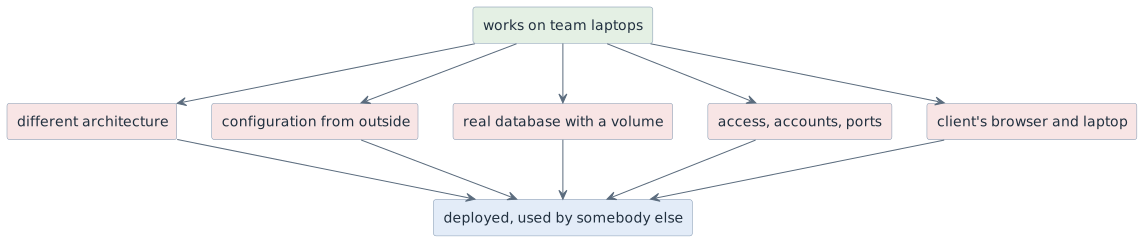
Every box in the middle has been a lesson in this course, and each is a place where software that "works" stops working. Discovering them in January costs an afternoon each; discovering them in March costs the scope.
The slice does not have to be impressive. One capability, reachable by somebody
else, with real configuration and a real volume, is worth more here than four
capabilities on localhost.
Points the answer must contain:
-
Deployment risk is invisible until tried and expensive when late
-
Architecture, configuration, persistence, access and the client’s environment
-
Not
localhost— reachable from a machine that is not the team’s -
One thin slice beats several local capabilities
The forecast does not fit the deadline. What do you bring to the review?
covers: lo-4
Answer
A proposal, not only the finding. "We will not finish" is a report; "we propose to drop X, keep Y, and here is what that costs the client and what it buys in weeks" is a decision somebody can act on.
Of the four levers, only two are real in a school project:
| Lever | At school |
|---|---|
scope |
the usable one: what is dropped or postponed, and what the client loses |
date |
fixed by the diploma thesis deadline |
capacity |
no extra people; redistribution is slower before it is faster |
quality |
only where named and bounded — never tests, never acceptance criteria |
A good scope proposal names what is dropped, why that one, what the client loses and what it buys in weeks. Bringing the number without the proposal leaves the hardest decision to the person with the least information about the project.
Points the answer must contain:
-
Bring a scope proposal, not only the forecast
-
Scope is the real lever; the date is fixed
-
Name what is dropped, why, the client’s loss and the weeks gained
-
Tests and acceptance criteria are not available as the quality lever
What do you look for when reviewing another team at this stage?
covers: lo-5
Answer
What remains, rather than what is past:
-
Does their forecast follow from their own numbers, or is it a hope with a date attached?
-
Is anything deployed where somebody else can reach it?
-
Which review-1 findings are still open, and does the team know that?
-
What is the one thing that ends the project if it goes wrong — and is it in their open questions?
-
Is there a dependency on one person, and what happens if that person is ill in March?
The last two decide the outcome at this stage. A team that cannot name its single biggest risk has not looked for it, and a named risk is manageable — which was true at review 1 and is more true now that there is less time to react.
Feedback rules are unchanged: location, defect, repair, written into the reviewed team’s repository during the session.
Points the answer must contain:
-
Check the forecast against their own archive
-
Deployment reachable by somebody else
-
Fate of review-1 findings
-
The single biggest risk and any single-person dependency
"We are aware of that finding." Why is that not an answer?
covers: lo-1
Answer
Because awareness is not a state in the life cycle. A finding from review 1 has exactly three possible outcomes: it became a change — open or archived — it was rejected in writing with a reason, or nothing happened. "We are aware" is the third one with better wording.
The distinction is not pedantry. A change has an owner, an exit condition and a date; a rejection has a reason somebody can disagree with. Awareness has none of those, cannot be checked, and reliably produces the same sentence again at review 3.
The honest version is short and costs nothing: "nothing happened; it is not recorded anywhere; we will open a change this week — or we drop it, and here is why." Both halves of that are acceptable answers. What is not acceptable is a finding that has been neither acted on nor decided against, four months into a project with a fixed deadline.
Points the answer must contain:
-
Three legitimate outcomes: change, written rejection, or nothing
-
Awareness is unowned, undated and uncheckable
-
A change has an owner and exit condition; a rejection has a reason
-
Saying "nothing happened" plainly is an acceptable answer