Learning outcomes
The difference from the first review
Milestone one asked whether the project had started properly. Milestone two asks whether it will finish, which is a different question and needs different evidence.
| Review 1 | Review 2 | |
|---|---|---|
Central question |
has it started properly? |
will it finish? |
Evidence |
charter, first specs, first archived changes |
throughput, trend, a deployed slice |
"Not much works yet" |
acceptable |
a finding |
Output |
findings |
findings and, where needed, a scope decision |
Looks at |
what has happened |
what remains |
The consequence for preparation: the numbers matter now. A team that arrives with three archived changes and no forecast has not prepared, however good the three changes are.
What is presented
The same rule as before — nothing that is not in the repository — with three additions.
-
The findings of review 1, and what became of each. Archived change, documented rejection, or nothing. "Nothing" is an answer, and it is the one everybody remembers.
-
The forecast. Measured throughput from
archive/, remaining scope, a range, and the assumption at each end. Plus the milestone trend: where the feature-complete date has moved since November. -
A deployed end-to-end slice, on a machine that is not the team’s. Not
localhost. This is the item that separates projects that will finish from projects that will discover deployment in March.
Then the familiar three: the three sentences (finished, next, blocked), the archive on screen, and a scenario chosen by the reviewers and run live.
Why the deployment is non-negotiable at this review
Because it is the risk that most reliably eats three weeks, and it is invisible until somebody tries it.
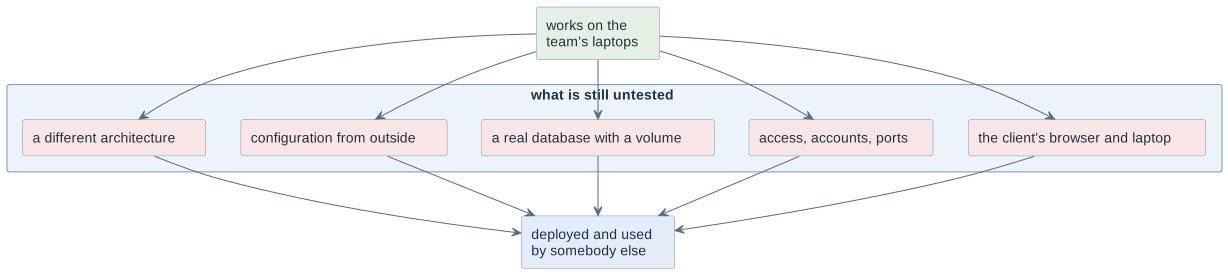
Every box in the middle has been a lesson in this course, and every one of them is a place where a project that "works" stops working. Discovering them in January costs an afternoon each; discovering them in March costs the scope.
A deployed slice does not have to be impressive. One capability, reachable by
somebody else, with real configuration and a real volume, is worth more at this
review than four capabilities on localhost.
The scope conversation
If the forecast does not fit the deadline, the review is where that is said — and, more importantly, where a proposal is made. "We will not finish" is a report. "We propose to drop X, keep Y, and here is what that costs the client" is a decision somebody can act on.
The four levers from governance-milestones apply, and in a school project only
two of them are real:
| Lever | At school |
|---|---|
scope |
the usable one. Which capability is dropped or postponed, and what the client loses |
date |
fixed by the diploma thesis deadline |
capacity |
no extra people, and a redistribution inside the team is slower before faster |
quality |
only where it is named and bounded — never tests, never acceptance criteria |
A good scope proposal names what is dropped, why that one, what the client loses and what it buys in weeks. Bringing the forecast without a proposal leaves the hardest decision to the person with the least information.
Reviewing forwards
For the reviewing team the question changes with the milestone. At review 1 you asked whether the foundations were there. Now:
-
Does their forecast follow from their own numbers — or is it a hope with a date attached?
-
Is anything deployed where somebody else can reach it?
-
Which findings from review 1 are still open, and does the team know?
-
What is the one thing that, if it goes wrong, ends the project? Do they have it in their open questions?
-
Is there any dependency on one person, and what happens if that person is ill in March?
The last two are the questions that make the difference at this stage. A team that cannot name its single biggest risk has not looked for it — and a risk that is named is manageable, which was true at review 1 and is more true now.
Decisions
-
Every team reports the fate of every finding from review 1, including the ones where the answer is "nothing".
-
A forecast with a range and its assumptions is presented. A status report is not accepted in its place.
-
A deployed end-to-end slice, reachable from a machine that is not the team’s, is required at this review.
-
Where the forecast does not fit the deadline, the team brings a scope proposal, not only the finding.
-
The milestone trend is recorded again, in the same file, so a third point exists.
-
Findings become changes or documented rejections within one week, as before.
Pitfalls
-
Reporting review-1 findings as "we are aware of it". Awareness is not a state in the life cycle.
-
A forecast that does not follow from the archive. If throughput says eight weeks and the team says four, the difference has to be explained by something other than optimism.
-
Demonstrating on
localhost. It postpones the deployment risk to the worst possible moment. -
Bringing bad news without a proposal, leaving the decision to somebody with less information than you.
-
Cutting tests as the quality lever. It is the one that removes the ability to tell whether the remaining work is finished.
-
Not naming the single biggest risk, because naming it feels like admitting it.
Terminology
| Deutsch | English |
|---|---|
Prognose |
forecast |
Trendanalyse |
trend analysis |
Umfangsentscheidung |
scope decision |
Inbetriebnahme |
deployment |
Risiko |
risk |
Restaufwand |
remaining effort |
Befund |
finding |
Further reading
-
Module
review-milestone-1— the format, the criteria and the feedback rules -
Module
governance-milestones— the trend chart and the four levers -
Module
governance-estimation-hygiene— where the forecast numbers come from