Learning outcomes
What is being reviewed
Nothing is presented that is not in the repository. That single rule decides the shape of the whole session: there are no slides, no status report and no percentage, because everything a reviewer needs is already committed.
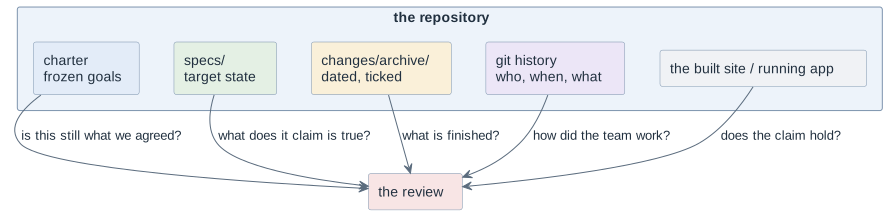
The first milestone falls early enough that "not much works yet" is an entirely acceptable answer. What is not acceptable at any milestone is not being able to say what is finished — because that is not a fact about the software, it is a fact about the team.
The criteria
Five, and they are known in advance because the point is not to catch anybody out:
| Criterion | Evidence | Not evidence |
|---|---|---|
Direction — the project still matches its charter |
charter goals, and the capabilities in |
"we changed direction a bit" |
Finished work — something is actually done |
archived changes with dated, ticked tasks |
open changes, branches, "almost done" |
Truth of the target state — |
a scenario from |
a spec nobody has run |
Way of working — the process is used, not performed |
commit history, pull requests, review comments |
a record written last week |
Open questions — the team knows what it does not know |
the list of assumptions and open questions, with sources |
"no problems" |
The last criterion surprises people. A team that reports no open questions is either not looking or not saying, and both are worse than a team with six honest ones. Risk that is named is manageable; risk that is denied is not.
Preparing: forty minutes, not a night
Preparation is repository work, and it is work you would have to do anyway:
-
Archive what is done. An unarchived finished change counts as unfinished, and this is where teams lose most of their visible progress.
-
Withdraw what is dead, one sentence each.
-
Run your own scenarios. Pick two from
specs/and execute them by hand. If one fails, that is a finding you get to report yourself rather than have found. -
Update the open-questions list — with sources, as in elicitation.
-
Write three sentences: what is finished, what is next, what is blocked.
That is the whole presentation. If it takes longer than forty minutes, the missing work is not presentation work.
Running the session
Roughly twenty minutes per team, in a fixed order, because the order is what keeps it from turning into a demo:
-
Three sentences — finished, next, blocked. Not a narrative.
-
One scenario, live. Chosen by the reviewers from
specs/, not by the team. -
The archive, on screen. What was archived, when, with which tasks.
-
Findings from the reviewing team.
-
Written record — the findings, in the repository, before the session ends.
The live scenario is the part that makes the rest honest. A team that can pick
any scenario will pick the one that works; a scenario the reviewers pick tests
whether specs/ is a description or a wish. When it fails — it often does at
milestone one — the useful response is "noted, that becomes a change", not an
explanation.
Feedback that is worth receiving
A review comment is useful when a reader who was not there can act on it. That means three parts, and the third is the one that gets left off:
| Not usable | Usable |
|---|---|
"The specs are weak." |
"`specs/booking` has no refusal scenario; add one for the full session, because that is where the bug will be." |
"Your git history is messy." |
"Eleven commits say 'fix'; a reviewer cannot find the change that introduced the sorting bug. Use the change id in the subject." |
"Good work!" |
"The attendance capability is the only one with three scenarios including a refusal — do that for booking too." |
Location, defect, repair. Praise follows the same rule, or it teaches nothing: a compliment that does not name what was good cannot be repeated on purpose.
On the receiving side, exactly one response is available during the session: write it down. Defending a finding is not forbidden because it is impolite; it is forbidden because it costs the ten minutes in which the other four findings would have been said.
After the review
Findings become changes, not good intentions. Each one either enters
changes/ with a reason and a task list, or is written down as consciously
rejected, with the reason.
That is the difference between a review that improves a project and one that produces a nice conversation. At the second milestone the first question is what happened to the findings of the first — and the answer is visible in the archive, or it is not there at all.
Decisions
-
Nothing is presented that is not in the repository. No slides.
-
The scenario demonstrated live is chosen by the reviewers.
-
Every team reviews another team; the findings are written into the reviewed team’s repository during the session.
-
Findings become changes or documented rejections within one week.
-
A team reporting no open questions is asked again; "none" is not an accepted answer at a first milestone.
-
The milestone assesses the state of the project, not the presentation of it.
Pitfalls
-
Preparing slides. It costs an evening and moves the truth further from the repository.
-
Demonstrating the one path that works. The reviewers choose, precisely for this reason.
-
Arriving with finished but unarchived work. It is invisible, and it is the cheapest possible loss of credit.
-
Defending findings in the session. It burns the time the remaining findings needed.
-
Feedback without a repair. It leaves the other team knowing something is wrong and not what to do.
-
Findings that go into a notes file and never become changes. By milestone two nobody remembers them.
Terminology
| Deutsch | English |
|---|---|
Meilenstein |
milestone |
Meilensteinprüfung |
milestone review |
Nachweis, Beleg |
evidence |
Behauptung |
assertion, claim |
Befund |
finding |
offene Frage |
open question |
Abnahme |
acceptance |
Further reading
-
Module
sdd-change-lifecycle— reading a project fromchanges/andarchive/ -
Module
bridge-charter-to-specs— how a milestone becomes checkable at all -
Module
git-pull-requests— the same feedback rules, in writing