What is the invariant pattern behind every process model?
covers: lo-1
Answer
The same loop, from the 1970s to this morning:
clarify the goal
  -> bound the scope
    -> state the requirement precisely
      -> build
        -> verify
          -> take the change in under control
No model skips a step. Waterfall does not omit verification, and Scrum does not omit stating requirements — a user story is a requirement, written shorter.
What differs between the models is how often you go round, and therefore how long an error can survive before anybody notices. That is the whole difference, and it is why comparing models by their vocabulary — sprints against phases, backlog against specification — misses the point. Compare them by the length of one pass.
Points the answer must contain:
-
Clarify goal, bound scope, state the requirement, build, verify, control the change
-
The steps do not differ between models — the frequency of the loop does
Place waterfall, Scrum and SDD by tempo and say what follows from each
covers: lo-2
Answer
| Model | Tempo of one loop | Consequence |
|---|---|---|
Waterfall / V-model |
months |
being wrong is found late and costs the most |
Scrum |
weeks |
being wrong is found at the sprint boundary |
Spec-driven development |
minutes |
being wrong is found while you are still holding the thought |
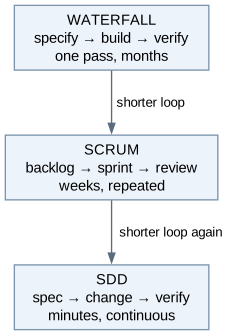
What follows is a cost, not a virtue. The later the loop closes, the later an error is found and the more work has been built on top of it in the meantime — a wrong assumption discovered after four months has four months of code standing on it.
But a short loop is not free either: it is only possible when one pass is cheap, which requires automated build and test and precise statements of what should happen. Without those, "short loop" just means guessing more often.
Points the answer must contain:
-
Months, weeks, minutes
-
The later you close the loop, the later and more expensively an error is found
-
Shorter loops require automation and precise statements
Why does the choice of process model not affect the charter?
covers: lo-3
Answer
Because the charter asks a different kind of question. It wants the initial situation, the objectives, the deliverable, the milestones and their dates — what is to be achieved and by when. It contains no field for "sprint", "phase" or "iteration", and no field asking how the team organises its week.
| Layer | Changes with the model? |
|---|---|
Governance — charter, goals, milestones, acceptance |
no, and it never asked which model you use |
Execution — how you get from goal to result |
yes, freely |
That separation is what made this course’s own switch from Scrum to spec-driven development possible without touching a single governance document. The school, the client and the examiner see exactly what they saw before.
It cuts the other way too, and that is worth saying: a team cannot use its process model as an excuse. "We are agile, so the deliverable moved" is not an argument the charter recognises, because the charter never granted the process model any authority over goals.
Points the answer must contain:
-
The charter asks for goals, deliverables, milestones and dates
-
It has no field for sprints, phases or iterations
-
Governance and execution are separate layers
Where has the uncertainty moved, now that code is cheap to produce?
covers: lo-1, lo-2
Answer
Out of writing the code and into saying precisely what the code should do and checking that what came out is what you meant.
A pass through the loop used to be dominated by implementation time. Two things changed that: automated build and test made verification nearly free, and agents turned a precise description into a working implementation in minutes. What did not get cheaper is deciding which behaviour is correct — that still takes a person who understands the domain.
The consequence for process models is direct. A model whose loop is measured in months invests most of its effort in coordinating the expensive implementation phase: freezing requirements early so that the build can proceed undisturbed. When the build is no longer the expensive part, that coordination is effort spent in the wrong place, and its main product is a requirements document that is already out of date when the build starts.
Points the answer must contain:
-
Out of writing code, into specifying precisely and verifying the result
-
A months-long loop invests effort where it is now least needed
When would you still choose a long loop?
covers: lo-4
Answer
When being wrong is irreversible or very expensive, and when the requirements are actually known.
-
A bridge, a medical device, a payment run, an aircraft component: you cannot iterate into correctness after deployment, so verification has to happen before building, in detail, and once.
-
A regulated environment where the specification is part of the approval: the document is a legal artefact, not only a working aid.
-
A well-understood domain with stable requirements — the twentieth payroll system for the same rules. A long loop wastes nothing here, because there is little to learn by trying.
The decision is per situation, not per person and not per company. The same team can run a long loop for the part that touches money and a short one for the reporting view next to it. What makes the choice defensible is naming the consequence of being wrong: if it is cheap and reversible, iterate; if it is neither, verify first.
Points the answer must contain:
-
Irreversible or expensive consequences, stable and well-understood requirements, regulated environments
-
The choice is per situation, not per person