Learning outcomes
One pattern
Every process model, from the 1970s to this morning, runs the same loop:
clarify the goal
  -> bound the scope
    -> state the requirement precisely
      -> build
        -> verify
          -> take the change in under control
What differs is not the steps. It is how often you go round — and therefore how expensive it is to be wrong.
| Model | Tempo of one loop | Consequence |
|---|---|---|
Waterfall / V-model |
months |
being wrong is found late and costs the most |
Scrum |
weeks |
being wrong is found at the sprint boundary |
Spec-driven development |
minutes |
being wrong is found while you are still holding the thought |
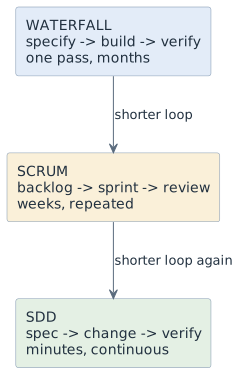
Why the tempo changed
The loop shortens when the cost of one pass falls. Two things have made a pass cheap: automation of build and test, and — recently — agents that turn a precise statement into an implementation in minutes.
That shifts where the uncertainty lives. It is no longer mainly in writing the code; it is in saying precisely what the code should do and in checking that what came out is what you meant. A model whose loop is measured in months puts its effort in exactly the wrong place.
Governance does not move
| Layer | Changes with the model? |
|---|---|
Governance — charter, goals, milestones, acceptance |
no, and it never asked which model you use |
Execution — how you get from goal to result |
yes, freely |
The diploma thesis application asks for initial situation, objectives, deliverable, milestones and dates. It contains no field for "sprint", "phase" or "iteration". So swapping Scrum for spec-driven development changes nothing that the school, the client or the examiner sees — which is why it can be done at all.
Choosing a tempo
-
The consequences of being wrong are irreversible and expensive (a bridge, a medical device, a payment run) — go slower, verify more before building.
-
The requirements are known and stable, the domain is understood — a long loop wastes nothing.
-
You are exploring, the requirement becomes clear by trying — the shortest loop you can verify.
Nobody picks a model for their whole life. They pick a tempo for a situation.
Decisions
-
This course teaches waterfall and Scrum in outline for the vocabulary, and spec-driven development as the working practice.
-
Process models are compared by tempo, not by manifesto.
-
Governance is taught separately from execution and stays constant across models.
Pitfalls
-
Believing a shorter loop means less thinking. It means the thinking is distributed differently and happens more often.
-
Treating "agile" as a synonym for "without a plan". Scrum has more meetings than waterfall, not fewer.
-
Adopting Scrum ceremonies in a school year without stable sprints. Velocity needs sprints that resemble each other; a school calendar does not provide that.
Terminology
| Deutsch | English |
|---|---|
Vorgehensmodell |
process model |
Wasserfallmodell |
waterfall model |
Iteration, Sprint |
iteration, sprint |
Taktfrequenz |
tempo, cadence |
Anforderung |
requirement |
Further reading
-
Module
process-waterfallandprocess-scrum— the two in outline -
Module
sdd-why-specs— why the shortest loop needs written specifications