Learning outcomes
The loop
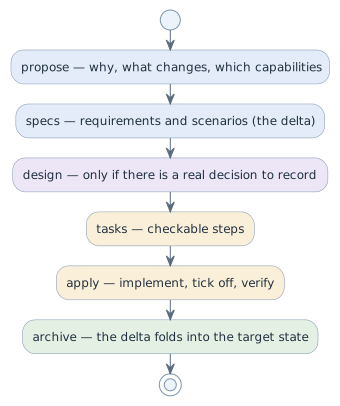
openspec propose              # create the change and its artefacts
openspec status --change x    # what is still missing
openspec apply                # work through the tasks
openspec validate --changes   # structure is sound
openspec archive              # fold the delta into specs/
The four artefacts
| Artefact | Answers | Fails when |
|---|---|---|
|
why now, what changes, which capabilities are touched |
it lists activities instead of a reason |
|
what must be true afterwards — the delta to the current target state |
it describes the implementation |
|
which decision was taken, which alternatives were rejected and why |
it is written for a change that had no decision to take |
|
which steps, in which order, and how each is verified |
a task has no way to tell whether it is done |
The design document is the one people either skip when they needed it or write when they did not. The test: was there a choice? If two reasonable options existed and you picked one, the reason is worth a paragraph — future you will ask. If there was only one way, there is nothing to record.
A change that is the right size
A change is one intention. It should be reviewable in one sitting and archivable as a whole.
| Too large | Right size |
|---|---|
"build the booking system" |
"refuse bookings for sessions that already started" |
touches eight capabilities |
touches one, maybe two |
three weeks of work |
days, with visible intermediate states |
If the tasks list is thirty items long and the first ten have nothing to do with the last ten, it is two changes. Splitting is cheap; unpicking a half-finished change is not.
Archiving
Archiving folds the delta into openspec/specs/ and moves the change into
changes/archive/. From then on the target state contains the new behaviour, and
the history of how it got there is intact. That is what makes a milestone
checkable: not "we worked on it", but "this change is in the archive, dated".
Decisions
-
Every piece of work in the project runs through a change — including documentation work.
-
Design documents are written when a decision was taken, not by default.
-
Changes are archived as soon as they are done, not collected for the end of the term.
-
Tasks state how they are verified. A task without a check is a wish.
Pitfalls
-
Writing the tasks before the specs. You then plan work whose target is not yet decided.
-
Archiving nothing all year and having twelve open changes in June. The archive is the milestone evidence — an empty one says the project produced nothing finished.
-
Implementing beyond the change. The extra work is invisible in the record and usually breaks something unrelated.
-
Treating
openspec validateas the definition of correct. It checks structure; whether the requirement is the right one is your judgement.
Terminology
| Deutsch | English |
|---|---|
Änderungsvorhaben |
change |
Vorschlag |
proposal |
Entwurfsentscheidung |
design decision |
Aufgabenliste |
task list |
archivieren |
to archive |
Further reading
-
openspec documentation and
openspec --help -
Module
sdd-change-lifecycle— the same loop, seen from the artefacts -
This repository’s own
openspec/changes/— a worked example at full size