Learning outcomes
-
Say what a stakeholder is, give examples, tell internal from external ones, and explain that each of them pursues interests of their own
-
Turn a wish into a goal that can be verified by someone else
-
Distinguish goals from non-goals and explain why non-goals are written down
-
Name the three dimensions a project goal is measured in, and tell Ergebnisziele from Vorgehenszielen
-
Agree a goal using the four questions: Wozu, für wen, Endergebnis, Erfolgskriterien
-
Recognise Zielkonkurrenz, Zielkomplementarität and Zielneutralität, and weight sub-goals instead of pretending they are equal
Stakeholders
A stakeholder is a person, a group or an organisation that is affected by the project, can affect it, or believes itself affected by it — the definition of ÖNORM ISO 21500. The last third matters: someone who wrongly believes they are affected still acts, and still costs you a meeting.
Every stakeholder pursues interests of their own, and those are not yours. They are usually legitimate, they routinely conflict with each other, and none of them is written on the ticket. That is the whole reason for listing them: a project fails at acceptance because somebody’s interest was never asked about, not because somebody was unknown.
| Interne Stakeholder | Externe Stakeholder | |
|---|---|---|
Who |
inside the organisation running the project: client, project management, the team, the departments whose work changes |
outside it: users, customers, suppliers, authorities, data protection, the public |
In a school project |
the team, the teacher supervising it, the school’s IT operations |
the club or company the project is for, its members, the parents, whoever hosts the server afterwards |
Typical interest |
a result that is defensible, on time, with no extra work landing on them |
a system that helps them rather than one that is merely delivered |
| Stakeholder | Their interest |
|---|---|
the trainer who records attendance |
to be finished faster than with paper — otherwise they simply will not use it |
the club’s committee |
to be able to show where the membership fees went |
members whose data is stored |
that as little as possible about them is stored, and that they can have it deleted |
whoever runs the server afterwards |
not to be woken up by it, and not to be left with something they cannot patch |
Goals that can be verified
A goal is verifiable when somebody who was not involved can check it without asking you what you meant.
| Wish | Verifiable goal |
|---|---|
"The app should be fast." |
"Opening the attendance list for a group of 30 takes under one second on the lab laptops." |
"Users should like it." |
"A trainer can record a full session without written instructions, in under two minutes." |
"The data must be safe." |
"Personal data is stored only for members with a signed consent, and can be deleted on request within one working day." |
The pattern: an observable action, a measurable condition, a context in which it holds. If your goal has none of those, it is a wish — write it down as one, but do not call it a goal.
Leistung, Termine, Kosten
Project goals are stated in three dimensions, and a goal that names only one of them is not yet agreed.
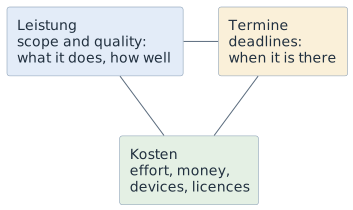
They are coupled: hold two of them and the third follows. In a school project Termine is fixed by the calendar and Kosten is fixed by the hours you actually have, which leaves exactly one adjustable dimension — Leistung. A team that refuses to adjust it ends up adjusting quality instead, silently.
Leistung has two halves and both belong in the goal: the Umfang (which
functions) and the Qualität (how well they have to work — the non-functional
side, see sdd-why-specs).
Ergebnisziele and Vorgehensziele
| Ergebnisziel | Vorgehensziel | |
|---|---|---|
Says |
what exists at the end |
how the work gets done on the way there |
Example |
"members can be enrolled in courses online" |
"the team meets weekly and keeps decisions in the repository" |
Checked |
at the acceptance, on the product |
during the project, on the way of working |
If it is missing |
nobody knows what was promised |
the result may be right and nobody can repeat it |
Both belong in the charter, marked as what they are. The frequent mistake is a charter full of Vorgehenszielen — meetings, tools, methods — with no statement of what will exist at the end.
The four questions of a goal agreement
Before a goal is written down it should survive four questions. They come from the Coverdale method and they are the fastest test there is.
| Frage | What it forces out |
|---|---|
WOZU? |
the purpose behind the goal. If the answer is "because it was asked for", the goal is not understood yet |
FÜR WEN? |
the stakeholder who benefits. A goal without a named beneficiary is usually somebody’s hobby |
ENDERGEBNIS? |
what concretely exists when it is reached — a thing, not an activity |
ERFOLGSKRITERIEN? |
how a third party recognises that it was reached |
Question four is the one that turns a wish into a goal, and questions one and two are the ones that occasionally delete a goal entirely — which is a good outcome, and much cheaper now than in May.
How goals relate to each other
Goals in the same charter are not independent, and the relationship has a name.
| Beziehung | Bedeutung |
|---|---|
Zielkonkurrenz |
reaching one makes the other harder — more functions against an earlier deadline. Must be decided, not averaged away |
Zielkomplementarität |
reaching one helps the other — a clean data model helps both the export and the deletion requirement |
Zielneutralität |
the two do not influence each other. Rarer than it looks |
Zielkonkurrenz is the interesting case: it is not a planning error, it is the normal state, and the charter’s job is to say which of the two wins when they collide.
Teilziele and their weight
A large goal is decomposed into Teilziele, hierarchically, until each part is checkable on its own. The parts are not equally important — pretending that they are is how a project ends up with a perfect export function and no working enrolment.
Weighting them is a small Nutzwertanalyse: give each Teilziel a weight, state
what the weight is based on, and the decision "what do we build first" becomes a
calculation rather than a mood. The method is in
governance-weighted-scoring.
Non-goals
Non-goals are what the project explicitly does not do. They cost one line each and prevent the two most expensive conversations of the year: scope creep during the project, and disappointment at the acceptance.
Non-goals:
  - no mobile app, browser only
  - no payment handling
  - no import from the old Excel sheets
A non-goal is not a promise never to do it. It is a statement that it is out of scope for this project, in this year.
Decisions
-
Every project charter names its stakeholders, marked as internal or external, with the interest each of them pursues.
-
Goals are written so a third party can check them; unverifiable goals go back to the team for rewriting.
-
Every goal states Leistung, Termin and Kosten, and is marked as Ergebnisziel or Vorgehensziel.
-
Competing goals are named as competing, with the decision which one wins.
-
Every charter has a non-goals section. An empty one is not accepted — if nothing is out of scope, the scope was not thought through.
Pitfalls
-
Only listing users and forgetting whoever has to operate or approve the thing.
-
Listing stakeholders without their interest. The name alone tells you nothing about what they will do at the acceptance.
-
Goals that measure your effort instead of the result ("we implement a REST API"). Nobody outside your team cares how it is built; they care what it does.
-
A charter of pure Vorgehenszielen: much method, no promised result.
-
Goals written after the fact, matched to what was finished. That is what the frozen charter exists to prevent.
-
Non-goals that are secretly plans ("no mobile app for now"). Then it is not a non-goal.
Terminology
| Deutsch | English |
|---|---|
Anspruchsgruppe, Beteiligter |
stakeholder |
interne / externe Stakeholder |
internal / external stakeholders |
Zielsetzung |
objectives |
Ergebnisziel |
result goal, outcome goal |
Vorgehensziel |
process goal |
Leistung, Termine, Kosten |
scope and quality, schedule, cost |
Zielkonkurrenz |
conflicting goals |
Zielkomplementarität |
complementary goals |
Zielneutralität |
independent goals |
Teilziel |
sub-goal |
Nicht-Ziel |
non-goal |
überprüfbar |
verifiable |
Einflussnahme |
influence |
Further reading
-
Template
templates/governance/projektauftrag.adoc— the goals table you fill -
Module
governance-weighted-scoring— how sub-goals get their weights -
Module
governance-acceptance— where these goals are checked again -
Module
sdd-why-specs— where the Qualität half of Leistung is written down -
ÖNORM ISO 21500 — the stakeholder definition used above