Which criteria make a piece of work a project? Give an example that fails one
covers: lo-1
Answer
A project is unique, time-bounded, resourced and goal-directed, and it is complex enough that it has to be organised. All five together — a single one is not enough.
| Work | Project? | Which criterion decides |
|---|---|---|
Your year project |
yes |
unique goal, fixed end, a team, a deliverable nobody has built yet |
Answering support mail |
no |
not unique and not time-bounded — continuous operation |
Migrating the school website to a new host |
yes |
one-off, dated, resourced, with a result that can be accepted or rejected |
Weekly backups |
no |
repeats; there is no end and no unique result |
Fixing a printer |
no |
routine, and not complex enough to need organising |
The distinction is not academic. If it is a project, somebody must be able to say afterwards whether it succeeded — and that is only possible if a goal was written down before the work started. Routine work is judged differently: it is judged by whether it keeps running.
Points the answer must contain:
-
Unique, time-bounded, resourced, goal-directed, complex enough to organise
-
Counter-example: routine work such as support mail — continuous, repeating, no unique result
What belongs in an initial situation, and what does not?
covers: lo-2
Answer
The Ausgangslage describes what exists today and what is unsatisfactory about it: who has the problem, what happens now, and what it costs in time, money or nerves. It does not describe your solution and it names no technology.
| Not an initial situation | An initial situation |
|---|---|
"We build an app with Spring Boot and a React frontend." |
"The club’s attendance list is kept on paper. Trainers copy it into a spreadsheet after training, which takes about twenty minutes a week and is often forgotten." |
"There is no digital solution yet." |
"Members cannot see whether a session is full before they arrive, so about a quarter of them travel for nothing." |
The test: could somebody who has never heard of your project recognise the problem? If the text only makes sense once your solution is known, it is a solution description wearing the wrong hat.
The consequence of getting this wrong is not stylistic. If the solution is written into the problem, then the question "was this the right solution?" can never be answered — the yardstick and the thing being measured are the same object. And "there is no app yet" is not a problem; nobody suffers from the absence of an app, they suffer from twenty minutes a week and from wasted trips.
Points the answer must contain:
-
Who has the problem, what happens today, what it costs
-
Not the solution, not the technology
-
Test: a reader who does not know your solution must still recognise the problem
Name the three constraints and explain which one moves in a school year
covers: lo-3
Answer
Scope (what is built), time (when it is due) and resources (people, money, machines). They are connected: changing one forces a change in at least one of the others.
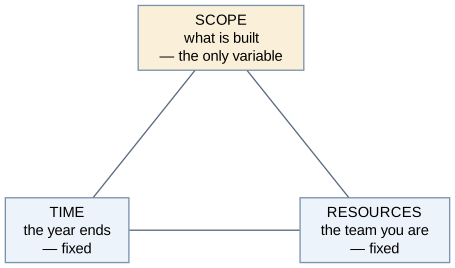
In a school year time is fixed — the year ends on its date — and resources are fixed — you are the team you are, with three afternoons a week. Only scope can move.
That is why a project that is "almost finished" in June is normally a project whose scope was never cut. And it explains the quiet failure mode: quality is not a fourth corner of the triangle, it is what gets sacrificed when the other three are all treated as fixed. Nobody decides to lower quality; it simply happens, without a decision anybody could later point to.
Points the answer must contain:
-
Scope, time, resources
-
Time and resources are fixed by the school year and the team
-
Scope is the only variable; if it is treated as fixed too, quality gives way silently
Where does the initial situation live in the project repository, and why there?
covers: lo-2
Answer
In openspec/config.yaml, under context: — unchanged, the same text that goes
into the project proposal.
The reason is the rule that runs through the whole course: one text, not two. If the initial situation lives in a Word document for the supervisor and in a paraphrase for the repository, the two drift apart within weeks, and then neither is authoritative.
Putting it there also means the agent reads exactly what the supervisor reads. It needs the same information and for the same reason: it is the only place that says what the work is for, and without it every proposal is judged only against what was literally asked for, never against the problem behind it.
Points the answer must contain:
-
openspec/config.yamlundercontext: -
One text instead of two; the agent and the supervisor read the same thing