Learning outcomes
Project or not a project
A project is a piece of work that is unique, time-bounded, resourced and goal-directed, and that is complex enough to need organising. Routine work has none of that: it repeats, it has no end date, and nobody writes a charter for it.
| Work | Project? | Why |
|---|---|---|
Your year project |
yes |
unique goal, fixed end, a team, a deliverable nobody has built yet |
Weekly homework |
no |
repeats, no unique goal |
Migrating the school website to a new host |
yes |
one-off, dated, resourced, with a result you can accept or reject |
Answering support mail |
no |
continuous operation, not a one-off result |
The distinction is not academic. If it is a project, somebody must be able to say afterwards whether it succeeded — and that requires a goal that was written down before the work started.
The initial situation
The German form calls it Ausgangslage. It describes what exists today and what is unsatisfactory about it. It does not describe your solution.
| Not an initial situation | An initial situation |
|---|---|
"We build an app with Spring Boot and a React frontend." |
"The club’s attendance list is kept on paper. Trainers copy it into a spreadsheet after training, which takes about twenty minutes a week and is often forgotten." |
"There is no digital solution yet." |
"Members cannot see whether a session is full before they arrive, so about a quarter of them travel for nothing." |
The test: could a person who has never heard of your project recognise the problem in the description? If the text only makes sense once your solution is known, it is not an initial situation.
|
This text goes into |
The three constraints
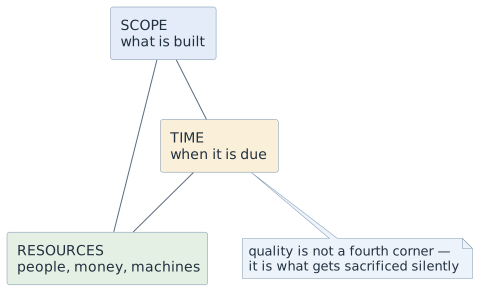
In a school year, time is fixed and resources are fixed: the year ends, and you are the team you are. Only scope can move. That is why a project that is "almost finished" in June is normally a project whose scope was never cut.
Decisions
-
Every team writes an initial situation before it writes anything else. Without it there is nothing to judge a result against.
-
Scope is the variable in this course. A team that runs late cuts scope and documents the cut as a change — it does not extend the year.
-
The initial situation lives in
openspec/config.yamlso that it is one text, not two.
Pitfalls
-
Writing the solution into the initial situation. Then every later question about "was this the right solution?" is unanswerable.
-
Choosing a problem nobody has. A project needs someone who is worse off today.
-
Treating quality as negotiable while pretending it is not. When time and scope are both fixed, quality is what actually gives.
Terminology
| Deutsch | English |
|---|---|
Projekt |
project |
Ausgangslage |
initial situation |
Zielsetzung |
objectives |
Rahmenbedingungen |
constraints |
Projektumfang |
scope |
Further reading
-
Template
templates/governance/projektantrag.adoc— the fields you will fill -
Module
governance-stakeholders-goals— turning a situation into verifiable goals