What is the difference between a milestone, a phase, a task and a deadline?
covers: lo-1
Answer
| Term | What it is |
|---|---|
milestone |
a point in time with a verifiable condition; no duration, no effort |
phase |
a stretch of time with a name; duration, no condition |
task |
a piece of work with an owner and an effort |
deadline |
a date with a consequence, usually external |
Only the milestone can be passed or missed observably. "We are in the implementation phase" cannot be false. "Attendance recording is archived and its two scenarios ran in front of the client" is either true or not, and everybody in the room can tell which.
That is why a milestone is neither a celebration nor a report: it is a question with a yes-or-no answer, agreed in advance.
Points the answer must contain:
-
Milestone = point in time plus verifiable condition, no duration
-
Phase has duration but no condition, so it cannot be missed
-
Task has effort and an owner; many tasks lead to a milestone
-
Deadline is an externally imposed date with a consequence
How do you write a milestone that somebody else can check?
covers: lo-2
Answer
By <date>, <observable condition> is true, checkable by <who> through <how>.
| Not verifiable | Verifiable |
|---|---|
"Backend finished" |
"By 2026-11-14 the capabilities |
"Testing done" |
"By 2027-02-06 every capability has a refusal scenario and the pipeline is green
on |
"MVP ready" |
"By 2027-03-06 a trainer records a full session end to end on the deployed system without help, observed by the client" |
Three properties of the right column: an observer outside the team, because self-certification turns a milestone into a ceremony; a named mechanism, so nobody invents the check on the day; and a condition about the behaviour of the system rather than the activity of the team, which is what lets it survive a change of plan.
The strongest criteria are machine-evaluable — "the pipeline is green on `main`" needs no meeting. Use those where they fit, but do not force them: the interesting milestones involve a person watching the software work.
Points the answer must contain:
-
Date, observable condition, external observer, mechanism
-
About system behaviour, not team activity
-
No self-certification
-
Machine-checkable where possible, a person watching where it matters
Where in the year do milestones belong?
covers: lo-3
Answer
Where the uncertainty is — their job is to convert an unknown into a known while the answer still leaves options.

Two rules carry most of the value.
The first thin end-to-end slice goes early. One capability from interface to database, deployed, says more about the project’s risk than three capabilities that all stop at the service layer. Deployment, authentication and the machine nobody has access to are what turn into three lost weeks, and they only surface when something is joined up.
Leave a milestone between feature-complete and the deadline. A slip discovered at the deadline has no answer; one found four weeks earlier can still be answered by cutting scope, which somebody is allowed to decide.
Points the answer must contain:
-
Milestones go where the uncertainty is, not at even intervals
-
An early deployed end-to-end slice exposes integration risk
-
At least one milestone well before the final deadline
-
The purpose is to leave options open, not to record history
What does a milestone trend chart show that a status report cannot?
covers: lo-4
Answer
A systematic slip.
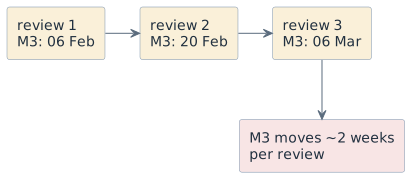
Each individual delay has a good reason and sounds like bad luck. Three in a row moving the same way is not luck — it is a rate, and a rate can be extrapolated to a date nobody wants.
A status report cannot show this because it only ever describes the present. The trend is built by recording, at every review, the expected date of every future milestone — which costs one line per milestone per review.
Honest use: raise the scope conversation early, while the options exist. Dishonest use: leave the date where it is and hope, which is how "we are on track" can be said truthfully every week until the last one.
Points the answer must contain:
-
Records the expected date of each future milestone at every review
-
Makes a systematic slip visible as a rate, not as a series of accidents
-
A status report only describes the present
-
Its purpose is an early scope conversation
A milestone is missed. What are the legitimate responses?
covers: lo-5
Answer
Four, and missing one is ordinary — what is assessed is what happens next.
-
Reduce scope. Something is dropped or postponed, in writing, as a charter conversation. The commonest and usually the right answer.
-
Add capacity. Rarely available at school, and slower before it is faster — a new person costs the team time first.
-
Move the date. Only where the date is not fixed. A diploma thesis deadline is not.
-
Accept lower quality, and only where somebody names what is given up — "no browser other than Chrome is tested". Never tests, never the acceptance criteria.
What is not a response: working more hours and saying nothing. It is unverifiable, it does not survive February, and it removes the one thing the milestone existed for — telling somebody else early that a decision is needed.
And the one move that destroys the instrument: lowering the criterion so it can be met. That converts the whole system back into a self-report.
Points the answer must contain:
-
Scope, capacity, date, quality — the four levers
-
Scope reduction is usually the right one and is a charter conversation
-
Silence plus overtime is not a response
-
Criteria are never lowered to be met
Why does "the implementation phase is complete" fail as a milestone?
covers: lo-1, lo-2
Answer
Because it cannot be false.
There is no condition anybody outside the team could check. The phase ends when the team says it ends, so the statement carries no information and the milestone records nothing except that a date passed. Every project reaches every phase.
It also fails the other two tests. There is no observer — the team certifies itself. And it describes team activity rather than system behaviour, so when the plan changes, the milestone becomes meaningless rather than merely missed.
The repair is to ask what would be observably true if the phase really were
complete, and to write that instead: "by 2027-02-06 all capabilities in specs/
are archived, the pipeline is green on main, and the reviewing team has run two
scenarios of their choosing on the deployed app." That can be failed — which is
the entire point.
Points the answer must contain:
-
No condition that can be false; every project reaches every phase
-
No external observer, so it is self-certification
-
Describes activity, not system behaviour
-
Repair: state what would be observably true, and who checks it