Learning outcomes
-
Explain why idea generation and idea selection are separated
-
Run a 6-3-5 brainwriting round and produce written results from it
-
Name the six techniques of this course and say which situation each one suits
-
Build a morphological box for a given problem and read combinations out of it
-
Explain how Bionik and the Delphi method differ from the intuitive techniques
Diverge first, converge later
Two activities, opposite rules, and the classic mistake is doing both at once:
| Diverging | Converging |
|---|---|
as many ideas as possible |
as few as necessary |
no evaluation, no "that won’t work" |
evaluation is the whole point |
quantity, variety, building on others |
criteria, weights, a decision |
this module |
next module — weighted scoring |
The moment somebody says "that’s not feasible" during the diverging phase, the group stops producing ideas and starts defending them. That is why the phases are separated in time, not just in intention: different hour, different rules, announced as such.
The six techniques
They are not six variants of the same thing. Three of them work by association, one by systematic combination, one by analogy, and one by structured expert opinion — and that is what decides which one you reach for.
| Technique | Works by | Reach for it when |
|---|---|---|
Brainstorming |
association, spoken |
a group, a warm-up, a broad question, fifteen minutes |
Methode 6-3-5 |
association, written |
a group in which not everybody speaks up; you need written results |
Mind mapping |
association, structuring |
one person or a pair; the area is unclear and needs ordering |
Morphologischer Kasten |
systematic combination |
the problem has clearly separable characteristics; you want completeness |
Bionik |
analogy from nature |
a technical problem that resists direct attack; nature has solved it already |
Delphi-Methode |
structured expert opinion, several rounds |
assessing something nobody can know for certain — a forecast, an estimate |
Brainstorming
The classic, and the one most often done badly. Five to twelve people, a moderator, somebody who writes everything down where all can see it, and about fifteen to thirty minutes. Four rules carry it:
-
No criticism. Not even "yes, but". Evaluation comes later, in a separate session.
-
Quantity before quality. The tenth idea is more interesting than the first, because the first three were everybody’s first three.
-
Wild ideas are welcome. It is easier to tame a wild idea than to enliven a tame one.
-
Build on what has been said. Combining and developing other people’s ideas is the point, not a lapse of originality.
Two weaknesses are worth naming, because they decide when you use a different technique. Only one person can speak at a time, so ideas are lost while waiting — Bewertungsangst and Produktionsblockierung are the German terms for the two effects. And a group with a strong personality in it produces that person’s ideas. Both are exactly what 6-3-5 removes.
Methode 6-3-5 (Brainwriting)
Six people, three ideas each, five minutes per round, six rounds. Every round the sheet moves one seat on, and you read what is there before you write.
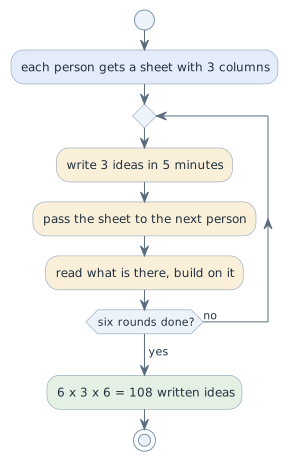
Why this one rather than a discussion:
-
Everyone contributes. In a discussion two people talk and four agree.
-
The result is written. No transcription step, no "what did we say?", and the sheets are raw material for the project proposals directly.
-
It is time-boxed by construction. The round ends because the sheet moves, not because somebody decides it does.
-
Building on others is forced. You read three ideas before writing your own.
The output is not 108 good ideas. It is perhaps five worth pursuing, and the other hundred are the price of finding them.
Mind mapping
The topic in the centre, main branches radiating outwards, one keyword per branch, sub-branches for detail. Colour and small drawings are not decoration: they are what makes the map re-readable a week later.
It is the technique for a single person or a pair, and its strength is that it generates and orders at the same time — you can see which area is thin and which is overgrown. Its weakness follows from the same property: the branch you started with attracts the most detail, whether or not it deserves it. In a group it degenerates quickly, because the person holding the pen decides the structure.
In this course you meet mind maps a second time as a representation rather than a technique — the curriculum overview on the start page is one.
Morphologischer Kasten
The systematic one, and the only one of the six that aims at completeness rather than inspiration. Fritz Zwicky’s idea: break the problem into its independent characteristics, list the possible values of each, and then read combinations across the rows.
| Characteristic | Value A | Value B | Value C | Value D |
|---|---|---|---|---|
Recording by |
the trainer |
the member |
a card reader |
automatic via wifi |
Device |
paper |
phone |
tablet at the door |
web page |
Time of recording |
before training |
during |
afterwards |
— |
Result goes to |
a file |
the club database |
the school system |
an e-mail |
Each row is a decision that can be taken independently of the others, so every
path across the rows is a possible solution: member + phone + before training
club database is one, trainer + tablet + during + club database is another.
Four rows with four, four, three and four values give 4 · 4 · 3 · 4 = 192
combinations — far more than a group would ever propose freely, and that is the
point: the box makes you see the combinations nobody thought of.
Two rules keep it usable. The characteristics must be genuinely independent — if choosing a value in one row forces a value in another, they are one characteristic, not two. And five to seven rows is the practical limit; beyond that the number of combinations stops being informative.
Bionik
Nature has been running a very long optimisation process, and its results are free to look at. Bionik transfers them: abstract your problem until it is a functional question, find a living system that answers that question, and transfer the principle back — not the shape.

The standard examples are worth knowing because each shows a different kind of transfer: the burdock burr became the hook-and-loop fastener (a mechanism), the lotus leaf became self-cleaning surfaces (a surface property), shark skin became riblet films that reduce drag on aircraft (a texture), termite mounds became passive building ventilation (a system principle).
The step people skip is the abstraction. Copying the shape of a bird’s wing gives you a bad wing; asking "how is lift produced with little energy" gives you something usable. In a school project the same move works on a smaller scale: "how does an anthill distribute work without a central plan" is a real question about a scheduling problem.
Delphi-Methode
The odd one out: it does not produce ideas out of nothing, it sharpens an assessment that no single person can make reliably — how long something will take, how a technology will develop, whether an approach carries.

Two properties do the work. Anonymity removes the effect that the loudest or most senior voice decides — nobody knows whose estimate is whose. And the fed-back summary lets each expert revise in the light of the others' reasons rather than their status, which is why the spread usually narrows over two or three rounds.
The price is time: written rounds take days, not minutes, and the method needs people who actually know something about the question. For a school project this matters mostly as a model — the milestone estimates in this course use the same two ideas in miniature, when everybody writes an estimate down before they are discussed.
Which technique for which situation
| Situation | Technique |
|---|---|
Fifteen minutes at the start, broad question, group is awake |
Brainstorming |
Group of six, quiet members, you need the result on paper |
Methode 6-3-5 |
You alone, an area you do not yet have a structure for |
Mind mapping |
The solution space has clear characteristics and you want all combinations |
Morphologischer Kasten |
A technical function you cannot solve directly |
Bionik |
An estimate or a forecast where opinions differ and nobody can prove theirs |
Delphi-Methode |
Decisions
-
6-3-5 is the technique actually carried out in this course. Brainstorming and the morphological box are practised in short form; Bionik and Delphi are understood and placed, not run.
-
Idea generation happens in the theory unit, without machines. It needs paper, not an IDE.
-
The sheets and the box are kept. They become the raw material for the project proposals in the following lessons.
-
SCAMPER is deliberately not part of this course. Six techniques that are actually used beat a seventh that is only listed.
Pitfalls
-
Evaluating during the diverging phase. It ends the phase.
-
Skipping the reading step in 6-3-5 and just writing your own three ideas again. The method then degenerates into six people writing alone.
-
A morphological box whose rows are not independent. If choosing "card reader" already fixes the device row, the two rows are one characteristic and the combination count is fiction.
-
Copying the shape in Bionik instead of the principle. The abstraction step is the method; without it you get decoration.
-
Running Delphi with three classmates and calling them experts. Anonymity does not create knowledge.
-
Asking an agent for "50 project ideas" and calling it done. You get plausible averages, not ideas anybody in the room cares about — and caring is what gets a project through February.
Terminology
| Deutsch | English |
|---|---|
Kreativitätstechnik |
creativity technique |
Ideenfindung |
idea generation |
divergieren / konvergieren |
diverge / converge |
Brainstorming |
brainstorming |
Methode 6-3-5, Brainwriting |
6-3-5 method, brainwriting |
Mindmapping |
mind mapping |
Morphologischer Kasten |
morphological box |
Merkmal / Ausprägung |
characteristic / value |
Bionik |
biomimetics |
Delphi-Methode |
Delphi method |
zeitlich begrenzt |
time-boxed |
Further reading
-
PUMA 8/12, Kreativitätstechniken — the source used for this module
-
Zwicky, F. — the morphological method, for the box
-
Module
governance-weighted-scoring— the converging half