Why are software estimates systematically too low?
covers: lo-1
Answer
Four mechanisms, none of them a matter of carelessness:
-
Planning fallacy — you estimate the work you can imagine. The work you cannot imagine is not estimated at zero; it is not estimated at all.
-
Anchoring — somebody says "two days?" and every later number clusters around two days, including yours.
-
The 90 % syndrome — the first 90 % takes 90 % of the time and the second 90 % takes the other 90 %.
-
Optimism under observation — an estimate given in front of the client or the group is lower than the same estimate written alone.
The consequence for practice is the point of the whole module: none of these is repaired by a better formula. They are repaired, partially, by hygiene — how the estimate is produced, phrased, recorded and revised.
A useful private test before saying a number: would I bet my weekend on it? The number that survives is usually the second one you thought of.
Points the answer must contain:
-
Planning fallacy, anchoring, 90 % syndrome, optimism under observation
-
Unimagined work is not underestimated but absent
-
A method does not fix any of them
-
Hygiene — phrasing, recording, revising — does part of the job
How should an estimate be phrased?
covers: lo-2
Answer
As a range with a named assumption and, where possible, a date at which the uncertainty will be smaller.
| Useless | Usable |
|---|---|
"Two days." |
"Between one and four days; I would be surprised at more than four." |
"Done by Friday." |
"Friday if the import format is what we think; otherwise a week later, and I will know which on Tuesday." |
"Half a day." |
"Half a day for the part I have done before; the OAuth part is unknown — give me two hours to find out." |
Three properties matter. The width of the range says how much you know, which the client needs more than the midpoint. The assumption is named, so somebody else can check it. And the date of reduced uncertainty turns an unpleasant "we do not know" into a schedulable step.
The width is not a weakness to be minimised. One-to-four honestly reported beats "two days" that becomes six — and the person reporting it stays believable, which is the asset everything else runs on.
Points the answer must contain:
-
Range, not a single number; width carries the confidence
-
Name the assumption so it can be checked
-
Say when the uncertainty will be smaller
-
A single number lets the listener invent a confidence you never gave
How do you forecast with your own measured throughput?
covers: lo-3
Answer
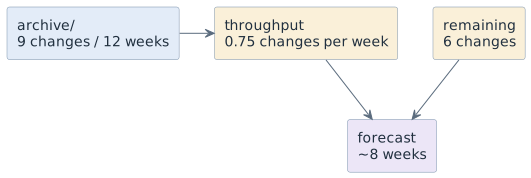
It beats a fresh guess for a reason unrelated to arithmetic: the measurement already contains everything that actually happened — the illness, the exam week, the afternoon lost to a broken build. A guess contains only the work somebody can imagine.
Two conditions. Changes must be roughly comparable in size, which is one more argument for cutting them small. And you count archived changes, not started ones.
Where there is no history — an unfamiliar technology — the honest move is not a bolder guess but a spike: a timeboxed investigation with a fixed budget whose deliverable is an estimate. "Two hours to find out, then I can tell you" is a professional answer, not an evasion.
Points the answer must contain:
-
Throughput = archived changes per week, from
archive/ -
It already contains the real interruptions; a guess does not
-
Requires comparable change sizes and counts only archived ones
-
No history → a timeboxed spike that produces the estimate
What is the difference between an estimate and a commitment?
covers: lo-4
Answer
| Estimate | Commitment |
|---|---|
prediction under uncertainty |
promise to somebody |
owned by whoever does the work |
owned by whoever makes the promise |
may be wrong without breaking anybody’s word |
may not be broken silently |
"one to four days" |
"you will have it Friday" |
Commitments are legitimate — projects need dates. What is not legitimate is converting an estimate into a commitment without saying so, which is what happens when somebody hears "one to four days" and writes "Tuesday" into a plan. The conversion happened, nobody announced it, and the person who gave the estimate is later held to a promise they never made.
Two rules, in both directions. If somebody turns your estimate into a date, say so: "that is a commitment now, and it assumes the import format is as expected." If you make a commitment, own it — and "it will not be Friday" is said as early as you know, not on Friday.
And when pressure comes: the negotiable quantity is scope, not the estimate. Moving scope is a charter conversation, held in the open.
Points the answer must contain:
-
Estimate = prediction, commitment = promise; different owners
-
Silent conversion of one into the other is the actual damage
-
Announce the conversion; report a broken commitment early
-
Under pressure, scope is negotiable and the estimate is not
When do you re-estimate, and what do you record afterwards?
covers: lo-5
Answer
An estimate describes the world as it was known at a moment. Re-estimate when that changes:
-
a named assumption turns out to be false;
-
the scope changes, in either direction;
-
a spike comes back and halves or doubles the uncertainty;
-
a milestone passes and the measured throughput differs from the assumed one.
Staleness is not a fault; silence about it is. Reporting "on track" until the deadline removes every option the other side had for reacting — which is the real cost, larger than the delay itself.
Afterwards, one line per archived change: what it actually took, next to what was estimated. Ten such lines are worth more than any method, because they are measurements of you rather than of software projects in general.
Points the answer must contain:
-
Triggers: falsified assumption, scope change, spike result, milestone
-
Report the re-estimate when it happens; silence is the fault
-
Late bad news removes the other side’s options
-
Record actual against estimated per archived change, to learn
Somebody asks you to lower your estimate. What do you do?
covers: lo-4, lo-2
Answer
Nothing to the estimate. Pressure is not an argument about the work, and the work does not become smaller because somebody looked unhappy.
What is genuinely negotiable is scope. "Four days for all of it. Two days if we drop the excused-absence case and take it in the next change" is a real answer, and it hands the decision to the person who owns it — because dropping a requirement is a charter conversation, not a private adjustment.
There is one legitimate way pressure changes the number: if the request comes with information. "You do not need the migration, the data is empty" is a fact that changes the estimate honestly. Ask for that explicitly — "what do you know that I do not?" — instead of quietly shaving the number.
Lowering it silently costs more than the days. It converts you into somebody whose estimates carry no information, and after that nobody can plan with them at all.
Points the answer must contain:
-
The estimate does not move; the work is unchanged
-
Offer scope alternatives instead, with the consequence stated
-
New information may legitimately change it — ask for it explicitly
-
Silent lowering destroys the credibility the estimates run on