Learning outcomes
Why the number is always too low
Every class has been told about function points and story points. This lesson is not about a method, because the method is not where projects lose their time. Four mechanisms are, and they are worth being able to name:
| Mechanism | What it looks like |
|---|---|
Planning fallacy |
you estimate the work you can imagine. The work you cannot imagine is not estimated at zero — it is not estimated at all |
Anchoring |
somebody says "two days?" and every subsequent estimate clusters around two days, including yours |
The 90 % syndrome |
the first 90 % takes 90 % of the time, and the second 90 % takes the other 90 % |
Optimism under observation |
an estimate given in front of the teacher, the client or the group is lower than the same estimate written alone |
None of these is fixed by a better formula. All four are fixed, partially, by hygiene: how the estimate is produced, phrased, recorded and revised.
| A useful private test before you say a number out loud: would I bet my weekend on it? The number that survives that question is usually the second one you thought of. |
A range, with a confidence
A single number carries no information about how sure you are, so the listener supplies their own assumption — usually "that is the plan".
| Useless | Usable |
|---|---|
"Two days." |
"Between one and four days. I would be surprised if it were more than four." |
"It’ll be done by Friday." |
"Friday if the import format is what we think it is; otherwise a week later, and I will know which on Tuesday." |
"Half a day." |
"Half a day for the part I have done before, unknown for the OAuth part — I want two hours to find out first." |
Three properties of the right column. The width of the range says how much you know, which is information the client needs more than the midpoint. The assumption is named, so somebody can check it. And there is a date at which the uncertainty will be smaller, which converts an unpleasant "we do not know" into a schedulable step.
The width is not a weakness to be minimised. A range of one to four days honestly reported is worth more than "two days" that turns into six — and the person who reports it stays believable, which is the asset the whole thing runs on.
Use your own numbers
The best estimator available to you is your own recent history, and you have been generating it all term without noticing.
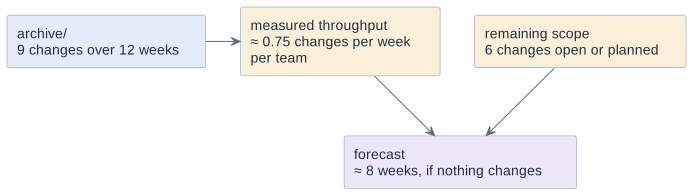
That forecast is better than a fresh guess for a reason that has nothing to do with arithmetic: it already contains everything that actually happened — the illness, the exam week, the afternoon lost to a broken build. A guess contains only the work somebody can imagine.
Two conditions for it to work. Changes have to be roughly comparable in size,
which is another argument for cutting them small. And you must count archived
changes, not started ones, for the reason from bridge-progress-and-milestones.
Where you have no history — a technology nobody has used — the honest move is not a bolder guess but a spike: a timeboxed investigation with a fixed budget whose deliverable is an estimate. "Two hours to find out, then I can tell you" is a professional answer.
Estimate and commitment are different objects
The single most useful distinction in this module, and the one that prevents most of the damage.
| Estimate | Commitment |
|---|---|
a prediction under uncertainty |
a promise to somebody |
owned by whoever does the work |
owned by whoever makes the promise |
may be wrong without anybody breaking their word |
may not be broken silently |
"one to four days" |
"you will have it on Friday" |
A commitment is legitimate — projects need dates. What is not legitimate is converting an estimate into a commitment without saying so, which is what happens when a manager or a teacher hears "one to four days" and writes "Tuesday" into a plan. The conversion happened; it just was not announced, and the person who gave the estimate is later held to a promise they never made.
Two rules follow, and they hold in both directions:
-
If somebody turns your estimate into a date, say so out loud: "that is a commitment now, and it is based on the assumption that the import format is what we think."
-
If you make a commitment, own it. "I said Friday and it will not be Friday" is said as early as you know, not on Friday.
| Pressure to lower an estimate is not an argument about the work. If the date is fixed, the negotiable quantity is scope, not the estimate — and moving scope is a charter conversation, in the open. |
When to re-estimate
An estimate is a statement about the world as it was known at a moment. When that changes, the estimate is stale, and staleness is not a fault — silence about it is.
Trigger a re-estimate when:
-
an assumption you named turns out to be false;
-
the scope changes, in either direction;
-
you learn something that halves or doubles the uncertainty — the spike came back;
-
a milestone passes and the measured throughput differs from the assumed one.
And a habit worth building for the next project: when a change is archived, write down what it actually took next to what was estimated. Ten of those lines are worth more than any method, because they are measurements of you.
Decisions
-
Estimates are given as a range with a named assumption. A single number is not accepted as an estimate.
-
Forecasts use the team’s measured throughput from
archive/, not a fresh guess. -
Where there is no history, a timeboxed spike produces the estimate; its budget is fixed before it starts.
-
Estimate and commitment are named as such. Converting one into the other is said out loud.
-
Every archived change records actual against estimated effort, in one line.
-
Re-estimation is triggered by a falsified assumption, a scope change or a milestone, and reported when it happens.
Pitfalls
-
A single number. The listener fills in a confidence you did not give.
-
Estimating in front of the group without thinking alone first — anchoring guarantees the numbers converge on the first one said.
-
Estimating the imaginable work and forgetting review, migration, deployment, documentation and the things not yet known.
-
Lowering an estimate because somebody looked unhappy. The work does not become smaller.
-
Reporting "on track" until the deadline. The bad news does not improve with age; it only removes the options for reacting to it.
-
Never comparing actual against estimate, and therefore learning nothing across the whole year.
Terminology
| Deutsch | English |
|---|---|
Schätzung |
estimate |
Zusage, Verpflichtung |
commitment |
Bandbreite |
range |
Planungsfehlschluss |
planning fallacy |
Ankereffekt |
anchoring |
Durchsatz |
throughput |
Zeitfenster, begrenzte Untersuchung |
timebox, spike |
Nachkalkulation |
actual versus estimate |
Further reading
-
Module
bridge-progress-and-milestones— where the throughput number comes from -
Module
governance-milestones— dates that can be verified -
Steve McConnell, Software Estimation — the standard treatment, if you want the methods after all