What is acceptance, and what changes at that moment?
covers: lo-1
Answer
Abnahme is the point at which the client declares that what was delivered is what was ordered. It is a formal act on a date, not a mood.
| Before | After |
|---|---|
the team decides what is finished |
the client has said what they accept |
defects are ordinary work |
defects are accepted, listed, or grounds for refusal |
the target state grows by changes |
the target state describes something signed off |
operating it is the team’s job |
responsibility passes with the handover |
The reason it must be a moment rather than a fading-out: a project that never ends never gets assessed and never gets handed over. Somebody, on a date, says yes or no — and in a diploma-thesis context that is the moment the work becomes a result rather than an activity.
Points the answer must contain:
-
A formal declaration by the client on a date
-
Decision authority moves from team to client
-
Defects change status; responsibility for operation transfers
-
Without the moment, the project cannot be assessed or handed over
Why are acceptance criteria written at the start?
covers: lo-2
Answer
Because criteria written at the end are written against what was built, and then the project measures its own output against itself. That failure looks entirely rigorous from the outside, which is what makes it dangerous.
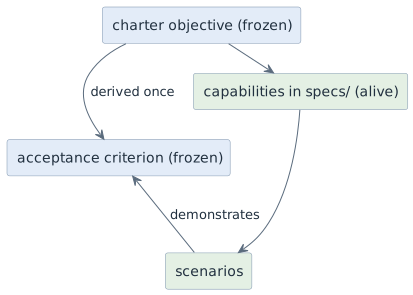
A usable criterion has the shape of a milestone criterion with the client as observer: "a trainer records a full session including one excused absence, on the deployed system, unaided, within five minutes" — an action, an observable result and the conditions it is tried under.
"On the club’s laptop" is not pedantry. It names where the acceptance actually happens, which is where the surprises are.
Points the answer must contain:
-
Derived from frozen charter objectives before the work begins
-
Criteria written afterwards measure the project against itself
-
Action, observable result, conditions — with the client as observer
-
Name the real environment, because that is where it will be tried
How is an acceptance session run?
covers: lo-3
Answer
-
The client operates the system — the team does not touch the keyboard. That single rule finds more defects than any test plan, because a demonstration only exercises the paths the team already knows work.
-
Every criterion is tried, in order, including the refusals.
-
Each outcome is recorded immediately: passed, passed with a defect, failed.
-
The defect list is agreed in the room, with a severity per entry.
-
A written protocol is signed by both sides.
The protocol names what was tested, on which version — a tag or a commit, not "the current one" — who was present, the result per criterion, the defect list with severities and deadlines, and the declaration.
The version is what makes it worth anything later: "it worked at the acceptance" can only be checked if somebody wrote down which build was in the room.
Points the answer must contain:
-
The client operates; the team does not demonstrate
-
Every criterion tried, including refusals, recorded immediately
-
Defect list with severities agreed in the room
-
Signed protocol naming the exact version tested
What is the difference between acceptance with defects and refusal?
covers: lo-4
Answer
Whether the purpose is served — not how many defects there are.
| Outcome | When |
|---|---|
accepted |
every criterion passes; small defects may still be listed |
accepted with defects |
usable for its purpose; defects listed, prioritised, with deadlines. The normal outcome |
refused |
a criterion carrying the purpose fails — a trainer cannot record a session at all |
Twenty cosmetic issues are an acceptance with defects. One broken central function is a refusal however good the rest is.
Refusal is not a catastrophe either: it is a documented state with a next step — a list of what must become true, and a new date. The genuinely damaging outcome is the third one teams drift into: an acceptance nobody declared, where the client is vaguely satisfied and nothing is written down. Six months later nobody can say whether the project was delivered.
Points the answer must contain:
-
The criterion is whether the purpose is served, not the defect count
-
Acceptance with defects is the normal and expected outcome
-
Refusal is documented, with what must be true and a new date
-
The undeclared, unwritten acceptance is the worst of the three
What must a handover contain?
covers: lo-5
Answer
Everything somebody who was not in the project needs to run it, change it and deploy it:
-
the running system and its access — deployed instance, accounts;
-
the source, its history, and the right to use it settled in writing;
-
how to build and run it — Dockerfile, compose file, pipeline, and a README somebody has followed on a clean machine;
-
the configuration without secrets, plus the list of secrets and where they come from;
-
the data, with a backup and a tested restore;
-
the target state —
specs/and the archive, the documentation that never had to be written separately; -
the open questions and known defects with severities;
-
one named contact, and until when they answer.
The test is one sentence: can somebody outside the project run it, change it and deploy it from what is written down? Try that on a person, not on your own imagination.
Credentials go through a channel the recipient controls — never a chat message, never the repository — and anything that was ever in the repository is rotated as part of the handover.
Points the answer must contain:
-
System and access, source and rights, build and run instructions
-
Configuration plus the list of secrets; data with a tested restore
-
specs/ and archive as the documentation; open defects with severities
-
A named contact; verify with an outsider; rotate secrets
Why must the team not operate the system during acceptance?
covers: lo-3, lo-1
Answer
Because a demonstration is not a test. The team walks the paths it knows work — in the order it always uses, with the data it always uses — and the result proves that the team can operate the system, which nobody doubted.
The client takes different paths. They click the thing the team never clicks, type a name with an umlaut, go back a page, and try the case that only exists at their club. That is precisely the input the acceptance is supposed to sample, and it cannot be simulated by people who have been staring at the software for six months.
There is a second, governance reason. Acceptance is the moment the client declares that what was delivered is what was ordered. A declaration about something they never touched is not a declaration about the system; it is a declaration about a performance. If it later turns out the software cannot do what was accepted, nobody can say whether it was ever tried.
Points the answer must contain:
-
A demonstration only exercises known-good paths
-
The client’s paths and data are what the acceptance is sampling
-
Acceptance is the client’s declaration, so the client must have used it
-
Otherwise "it was accepted" says nothing about the system