Learning outcomes
What a pull request is
A pull request is a request to merge a branch, plus a place to discuss it before that happens. Technically it adds nothing to git — you could merge locally. What it adds is a moment where somebody else looks.
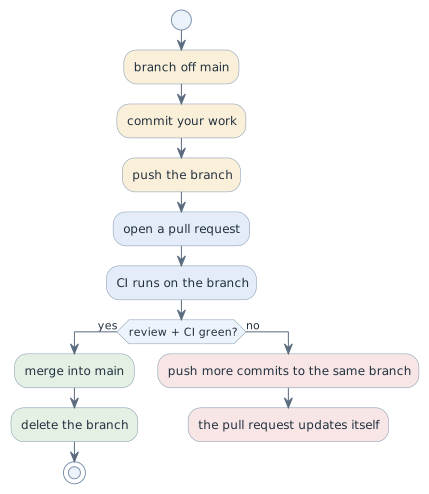
git switch -c feature/attendance-export
# ... commits ...
git push -u origin feature/attendance-export
gh pr create --fill          # or open it in the web interface
gh pr view --web
Branch or fork: who is allowed to push?
A pull request always says the same thing: "please merge branch X of repository A into branch Y of repository B". Whether A and B are the same repository depends on one question — do you have write access?
| Situation | What you need |
|---|---|
Your team’s project repository, you are a collaborator |
a branch in that repository; you can push, so nothing else is required |
Somebody else’s repository — the exercise repositories of this course, an open-source project, another team’s repo |
a fork: your own copy under your account, because you cannot push to theirs |
A fork is a copy of the repository on GitHub, under your own account, with a link back to the original. You have write access to your copy and none to the original — and that is exactly what makes the pull request necessary: it is the mechanism by which somebody without write access can still propose a change.

gh repo fork htl-leonding-example/jg03-syp-git-basics --clone   # fork + clone
cd jg03-syp-git-basics

# after a fork made in the web interface instead:
git clone git@github.com:<you>/jg03-syp-git-basics.git
cd jg03-syp-git-basics
git remote add upstream git@github.com:htl-leonding-example/jg03-syp-git-basics.git

git remote -v          # origin = your fork, upstream = the original
git switch -c feature/exercise-3
# ... commits ...
git push -u origin feature/exercise-3
gh pr create --repo htl-leonding-example/jg03-syp-git-basics --fill
Two remotes, two jobs: origin is your fork — you push there. upstream is
the original — you only ever read from it.
Keeping the fork in sync
A fork does not update itself. After a week your main is behind the original,
and every branch you start from it carries that gap into the pull request.
git fetch upstream
git switch main
git merge upstream/main      # or, in one step:  gh repo sync
git push                     # your fork's main is level again
git switch -c feature/next   # start the next branch from here
Do this before you start a branch, not after the conflict.
| In your own team project you are a collaborator, so a branch is enough and a fork would only add a second copy to keep in step. Fork when you cannot push — which in this course means the exercise repositories, and later every open-source contribution you make. |
Writing a pull request others can review
The description answers three questions, in this order:
-
What does this change, for the user of the system?
-
Why this way? — the alternative you rejected, in one sentence
-
How did you check it? — the test, the command, the screenshot
A pull request that says "fixes stuff" forces the reviewer to reconstruct all three. A description of five lines saves twenty minutes of someone else’s time.
Keep it small. A pull request of fifty lines gets a real review; one of two thousand gets "looks good to me", which is not a review, it is a signature.
Reviewing
| Useless comment | Useful comment |
|---|---|
"This is wrong." |
"If |
"I don’t like this name." |
"`data` here is a list of bookings; |
"LGTM" after ten seconds |
"Checked the CSV export against the sample file; the date column is off by a day in the DST week." |
Review the change, not the person. Say what you checked, so the author knows what was not checked. And approve only what you actually understood — an approval is a statement about your reading, not about your trust in the author.
Decisions
-
Everything reaches
mainthrough a pull request, including documentation. -
Exercise repositories are forked; the project repository is not — there everybody is a collaborator and works on branches.
-
At least one review from another team member before merging.
-
CI must be green before merging. A red build is not merged "and fixed later".
-
Pull requests stay small enough to read in one sitting.
Pitfalls
-
Approving without reading. The review then certifies nothing, and everyone behaves as if it had.
-
A pull request that mixes a rename with a behaviour change. The diff hides the behaviour change inside three hundred renamed lines.
-
Answering review comments by force-pushing a rewritten branch. The reviewer loses the thread of what changed since their comment.
-
Leaving pull requests open for a week. The branch drifts from
mainand the merge becomes a conflict exercise. -
Working on
mainof your own fork. It is your copy, so nothing stops you — and then the pull request contains every commit you ever made and cannot be synced with the original any more. -
Forgetting the
upstreamremote. The fork then never catches up, and the pull request arrives with commits the original already has. -
Opening the pull request against your own fork’s
maininstead of the original. GitHub preselects the original, but not after you have changed the base once.
Terminology
| Deutsch | English |
|---|---|
Zusammenführungsantrag |
pull request |
Begutachtung, Durchsicht |
review |
Freigabe |
approval |
Rückmeldung |
feedback |
Änderungsumfang |
scope of the change |
Abspaltung, eigene Kopie |
fork |
Gegenstelle |
remote |
ursprüngliches Repository |
upstream |
Further reading
-
GitHub docs — About pull requests, https://docs.github.com/pull-requests
-
GitHub docs — Working with forks, https://docs.github.com/pull-requests/collaborating-with-pull-requests/working-with-forks
-
Module
git-conflicts-remotes— what happens when two branches touch the same lines