Learning outcomes
Local, remote, and the copy in between
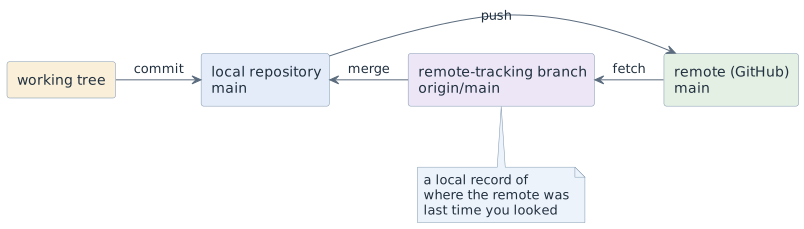
origin/main is not the remote. It is your local note of where the remote’s
main was when you last fetched. git pull is git fetch followed by
git merge — one command doing two things, which is why its failures confuse.
git remote -v            # which remotes exist
git fetch                # update the notes, change nothing else
git status               # ahead / behind / diverged
git pull                 # fetch + merge
git push                 # send your commits
Conflicts
A conflict happens when two branches changed the same lines and git cannot decide which version wins. That is not a failure of git — it is git refusing to guess.
<<<<<<< HEAD
    return members.size() / groups;
=======
    return groups == 0 ? 0 : members.size() / groups;
>>>>>>> feature/guard-empty-groups
Resolving it means: read both sides, decide what the code should do, delete the
markers, and test. Then git add the file and continue the merge.
git merge feature/guard-empty-groups   # conflict reported
git status                             # which files conflict
# edit, remove all <<<<<<< ======= >>>>>>> markers
git add Attendance.java
git commit                             # completes the merge
git merge --abort                      # or: get out and think again
The two rules that prevent most conflicts: short-lived branches, and small
changes. The rule that makes them harmless: resolve them yourself, at the moment
they appear, on your own branch — never in a hurry on main.
Common broken states
| Symptom | What it means and what to do |
|---|---|
|
the remote has commits you do not have — |
|
both sides have new commits — merge them; do not force-push |
You committed to |
|
|
do not, on a shared branch. It deletes other people’s commits |
Decisions
-
Nobody force-pushes a shared branch. If a history really must be rewritten, the team does it together, on purpose, once.
-
Conflicts are resolved on the feature branch, before the pull request is merged.
-
git pullbefore you start working, and before you push. -
A resolved conflict is only resolved once the build passes — the markers being gone proves nothing.
Pitfalls
-
Resolving a conflict by taking "your" side wholesale. Half the time the other side contained the fix.
-
Leaving a stray
=======in the file. It compiles in some languages, which is worse than a syntax error. -
Believing
git fetchchanged your files. It updates the remote-tracking branch only — that is what makes it the safe command. -
Pulling with uncommitted changes and then being unable to explain the state. Commit or stash first.
Terminology
| Deutsch | English |
|---|---|
Konflikt |
conflict |
Gegenstelle, entferntes Repository |
remote |
holen / zusammenführen / senden |
fetch / merge / push |
auseinandergelaufen |
diverged |
Konfliktmarkierung |
conflict marker |
Further reading
-
Pro Git, chapter 3.5 — Remote branches, https://git-scm.com/book
-
Module
gh-actions-pages— where a green build becomes the condition for a merge