Why must data and configuration live outside the image?
covers: lo-1
Answer
Because the image is immutable and identical everywhere, and that is the property worth protecting.
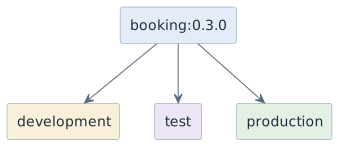
If the database password were baked in, three environments would need three images — and the image that was tested would not be the image that runs. In one sentence: the thing you tested must be the thing you ship, so everything that differs between environments comes from outside.
Two different kinds of thing come from outside and behave differently. State — database files, uploads — must survive the container, and that is volumes. Configuration — hostnames, ports, switches, credentials — differs per environment, and that is environment variables and mounted files.
Points the answer must contain:
-
One image for all environments; the tested one is the shipped one
-
Baked-in configuration forces one image per environment
-
State (volumes) and configuration (env/files) are separate concerns
-
The container’s writable layer dies with the container
Named volume or bind mount?
covers: lo-2
Answer
| Named volume | Bind mount | |
|---|---|---|
command |
|
|
managed by |
Docker, own storage area |
you, an ordinary host path |
portable |
yes, same command anywhere |
no, depends on path and permissions |
use for |
service state: databases, uploads |
files a human edits |
Rule of thumb: named volume for state the service owns, bind mount for files a human edits.
A database on a bind mount works on your machine and then produces permission and performance problems on the first machine that is not yours — which is the one that matters. Conversely a named volume for source code during development is useless, because you cannot edit it with your editor.
And one warning attached to volumes: docker volume rm and docker volume prune
delete data without confirmation and without undo.
Points the answer must contain:
-
Named volume: Docker-managed, portable, for service state
-
Bind mount: host path, for files a person edits
-
Databases on bind mounts break on other machines
-
Volume removal is irreversible and unconfirmed
How does configuration reach a container?
covers: lo-3
Answer
Three ways, in increasing capacity:
docker run -e DB_HOST=db -e LOG_LEVEL=info booking:0.3.0
docker run --env-file ./local.env booking:0.3.0
docker run -v "$PWD/application.yaml:/app/application.yaml:ro" booking:0.3.0
Single values as -e; many values from an --env-file that is not in the
repository; whole configuration files mounted read-only.
The application must be written to accept them, which is a design rule rather than a Docker one: read configuration from the environment, with sensible defaults, and fail loudly when something required is missing. A service that starts with an empty password and only fails on the first request is much harder to debug than one that refuses to start.
The :ro is worth its four characters: a writable config mount can be modified
by the container, after which the file on the host no longer matches what anybody
committed.
Points the answer must contain:
-
-e,--env-file, and a read-only mounted config file -
The env file is not committed
-
The application fails loudly on a missing required value
-
:roprevents the container from editing the host’s file
Where must a secret never be, and where does it go instead?
covers: lo-4
Answer
| Not in | Because |
|---|---|
the image |
every layer is readable with |
the repository |
git keeps it after deletion; a public repo publishes it at once |
the command line |
|
the log |
logs are collected, forwarded and read by other people |
What is left, in order of preference:
-
a secret file mounted read-only and referenced by path — the
*_FILEconvention most images support; -
an environment variable from an
--env-filethat is in.gitignore; -
for the pipeline, the repository secrets of GitHub Actions, injected at run time.
The piece that makes this workable in a team is a committed .env.example with
the names and dummy values: the next person knows what to set, and nobody ever
sends a password over chat.
And the rule that follows from all four rows: a secret that has been in an image, a commit or a public log is burnt. Rotate it — deleting the file changes nothing.
Points the answer must contain:
-
Not in image, repository, command line or log — with the reason for each
-
Mounted secret file, env-file in
.gitignore, pipeline secrets -
.env.exampledocuments the names without the values -
A leaked secret is rotated, not deleted
How do you back up and restore the data of a containerised service?
covers: lo-5
Answer
docker run --rm -v bookingdata:/data -v "$PWD:/backup" alpine:3.20 \
  tar czf /backup/bookingdata-2026-11-14.tar.gz -C /data .

docker volume create bookingdata_restored
docker run --rm -v bookingdata_restored:/data -v "$PWD:/backup" alpine:3.20 \
  tar xzf /backup/bookingdata-2026-11-14.tar.gz -C /data
A throwaway container that can see the volume does the work; the volume itself needs no running service.
For a database the better backup is its own dump — pg_dump rather than a file
copy — because a file-level copy of a running database can catch it mid-write.
The tar approach is right for uploads, and for volumes whose service is stopped.
Two habits: stop the service before a file-level backup, and write the restore command down next to the backup command, because the restore is what you will need under pressure and it is the half nobody has practised.
The summary sentence: a service whose data has never been restored does not have a backup, it has a hope.
Points the answer must contain:
-
A helper container mounts the volume and tars it out
-
Restore into a fresh volume the same way
-
Databases: use their own dump, not a file copy of a running instance
-
An untested restore is not a backup
A team keeps three images — dev, test and prod. What is wrong?
covers: lo-1, lo-3
Answer
The image that was tested is not the image that runs, so the testing proves nothing about production.
Whatever differs between the three — a hostname, a password, a feature switch — was baked in at build time, which means each image was built separately and any of the three builds could differ in ways nobody intended: a different base layer pulled, a dependency resolved to a newer patch, a file copied on one machine and not another.
The repair is mechanical. One image, built once, tagged with a version, and
promoted unchanged from test to production. Everything environment-specific
arrives at run time through -e, an --env-file or a read-only mounted config
file, and the application fails loudly if a required value is absent.
The second, quieter problem: three images means the credential is inside at least one of them, which brings back the rule that a secret in a layer is readable and permanent.
Points the answer must contain:
-
The tested artefact is not the shipped one; testing loses its meaning
-
Separate builds can differ in unintended ways
-
One image promoted unchanged; configuration injected at run time
-
Baked-in configuration usually means a baked-in secret as well