Learning outcomes
This lesson is organisational and carries no exam questions of its own. What it should leave you with:
-
the four subject areas of this course and what each one is for
-
how a lesson is split into theory and practice, and where the project work happens
-
how you are assessed and where the exam questions come from
The topics behind these points are examined in their own modules.
What this subject is about
The course has four areas. They are not four unrelated topics — they are the outer frame, the inner work, the way you describe a system, and the tools you need to do any of it.
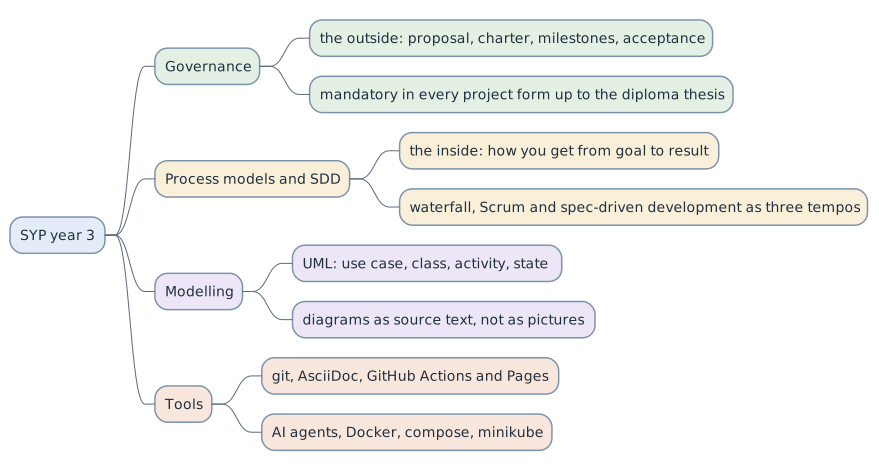
The distinction that runs through the whole year:
| Governance (outside) | Execution (inside) | |
|---|---|---|
What it fixes |
goals, deliverable, milestones, responsibility |
how the work is done |
Who prescribes it |
the school, the client, later the diploma thesis rules |
your team |
Changes during the project? |
no — it is frozen and stays the yardstick |
constantly, and visibly |
Where it lives |
|
|
A project charter never says "use Scrum". It asks what you want to achieve and by when. That is why the execution side could change — from Scrum to spec-driven development — without touching the governance side at all.
How the year runs
A lesson is three units: one unit of theory, two units of practice.
1 UE theory     the idea, the vocabulary, the decision
2 UE practice   your hands on the keyboard
The order is not the order of a textbook. It follows what you need to be able to do next: git before you can hand anything in, AsciiDoc before documentation means anything, an agent before spec-driven development is more than a claim.
Project work happens outside the lesson. Lesson time is input, review and getting unstuck. Three lessons in the year are milestone reviews, where the team shows what exists and compares estimate against reality.
Assessment
Assessment has two parts, and they ask different things of you.
Four written exams over the year — normally two per semester. They cover the modules taught up to that point and are answered in writing, under time. What they check well is breadth: whether the vocabulary, the distinctions and the procedures are available to you without looking them up.
Oral examinations. They check depth: whether you can explain a result, justify a decision, and say what you would do differently. That is a deliberate choice and it follows from something you already know: an agent produces a plausible solution to almost any exercise in seconds. An exercise handed in is therefore no longer proof of anything.
So the exercises stop pretending to be proof and become what they are — an
occasion to learn. Every module ships its exam questions with it, in
questions.adoc, and both the written exams and the oral examination draw on
that same catalogue. Nothing is hidden, nothing is unlocked later.
|
Read the questions of a module before you work through it. They tell you what the module is for, which is more useful than reading the text twice. |
Decisions
-
The course language is English. Governance terms are additionally taught in German, because the forms you fill in later — the diploma thesis application above all — are German.
-
Everyone works on Ubuntu 26.04 LTS or macOS. WSL2 is not an option here; the module on the learning environment says why.
-
Solutions are not hidden. The proof of competence is the oral exam.
-
Exercises marked
projectrefer to your own team project and have no model solution.
Pitfalls
-
Treating the exercise as the deliverable. The deliverable is that you can explain it afterwards.
-
Postponing the environment setup. Everything from the second lesson on assumes a working machine, and a broken installation costs an afternoon, not ten minutes.
-
Reading only the theory unit. Half the subject is in your hands, not in the slides.
Terminology
| Deutsch | English |
|---|---|
Unterrichtseinheit (UE) |
teaching unit |
Leistungsfeststellung |
assessment |
mündliche Prüfung |
oral examination |
Jahresprojekt |
year project |
Lernziel |
learning outcome |
Further reading
-
Module
learning-environment-setup— what to prepare before the next lesson -
Module
what-is-software-engineering— why this subject exists at all