Why is "we are 90 % done" not a progress measure?
covers: lo-1
Answer
Because it is self-reported against an estimate of the whole, and both halves are guesses. "90 %" means 90 % of the tasks somebody thought of, weighted by how long somebody guessed each would take. Neither the list nor the weights were ever checked.
| The claim | What it rests on |
|---|---|
"60 % done" |
60 % of the tasks somebody thought of, weighted by guesses |
"the backend is finished" |
finished until the first requirement it cannot satisfy appears |
"only testing left" |
testing is where unfinished work becomes visible, not where it ends |
The common defect: nothing named is checkable by anybody else. That is also the repair — replace the number with statements somebody else can verify, and the conversation changes shape completely.
The empirical version of the same point is old and reliable: the second 90 % of a project takes as long as the first.
Points the answer must contain:
-
Self-reported against an estimate; both parts are guesses
-
Not checkable by anyone else
-
"Only testing left" mistakes where the unknown work surfaces
-
Replace with statements that can be verified
How do you derive progress from archived changes?
covers: lo-2
Answer
By counting capabilities reached, per charter objective.
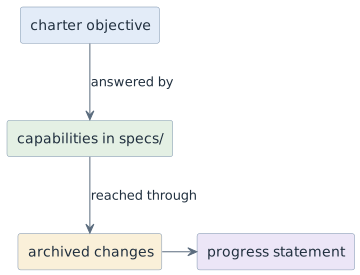
The report is a table, not a number:
| Objective | Capabilities | What is missing |
|---|---|---|
Trainers record attendance digitally |
2 / 3 |
history view; spec exists, no change open |
Members see their own bookings |
0 / 2 |
blocked on authentication, still an open question |
Monthly export |
1 / 1 |
done, archived 2026-11-14 |
Three properties make it better than a percentage: it names what rather than how much, it is falsifiable — run the scenario — and it is written in the client’s vocabulary. The third column carries the reason, including admitted dependencies; a report without such a row usually had nobody look hard at it.
Points the answer must contain:
-
Charter objective → capabilities → archived changes
-
Report as a table of capabilities done per objective, with what is missing
-
Falsifiable: any row can be checked by running a scenario
-
An unarchived change counts as not done
What does a team’s working rhythm predict?
covers: lo-3
Answer
The rest of the project. That is the only reason to look at it.
| History | Prediction |
|---|---|
steady commits, several authors |
the team can absorb a surprise in April |
three silent weeks, then forty commits |
the next silence is also three weeks, and it will fall in April |
one author for 90 % of the work |
single point of failure; in June only one person can defend it |
all commits after 22:00 before a review |
the review is being prepared for, not passed |
None of these is a statement about character; they are patterns with predictive value. A milestone review is supposed to say something about what is ahead, not only to score what is behind.
Which is why the useful question to a bursty team is not "why did you do nothing in November?" but "what will you do differently so February is not November?"
Points the answer must contain:
-
The history shows how the work happened, the archive only what was finished
-
Steady and distributed predicts resilience; bursty predicts more bursts
-
Single-author history is a single point of failure
-
The point is the forecast, not the judgement
What can the repository not show, and how is that covered?
covers: lo-4
Answer
Four things:
-
Effort — two hours of thinking that avoided a wrong design leave no trace; a hundred formatting commits leave plenty.
-
Understanding — a team can archive changes an agent produced and be unable to explain them. This is a genuine risk of working this way, and it is exactly why the oral exam exists.
-
Difficulty — an archived change does not say whether it was trivial or took three attempts.
-
Contribution beyond commits — whoever ran the interview, drew the model or unblocked somebody appears nowhere.
The first three are covered by the conversation: reviewers ask, and the answer either comes or does not. The fourth is covered by making the non-code work into artefacts — the interview protocol, the assumption list and the review findings are committed, and then they count.
Being explicit about these limits is what keeps the measure trustworthy. A measure that claims to capture everything gets gamed; one that states its blind spots gets supplemented.
Points the answer must contain:
-
Effort, understanding, difficulty, non-code contribution
-
Understanding is checked in the oral exam, not in the repository
-
Commit count is not effort
-
Non-code work is committed so that it counts
How is individual responsibility shown without a separate report?
covers: lo-5
Answer
From the record that the normal way of working produces anyway:
-
commits and their authors;
-
pull requests — who opened, who reviewed, who merged;
-
the change folder — who wrote the proposal, who wrote the tasks;
-
review findings that person wrote into another team’s repository.
That is enough for a defensible statement about an individual and it costs no extra paperwork, which is the point. A separate contribution report is written at the end, from memory, by whoever is most motivated to look good — it measures motivation to write reports.
One caution: a record showing a single author for everything is a finding about the team, not only about its quiet members. Reviewing each other’s pull requests is the cheapest fix, and it has to start early enough to be visible in the record.
Points the answer must contain:
-
Commits, pull requests, change authorship, review findings
-
No separate contribution report; it is written from memory and biased
-
The evidence accumulates as a by-product of normal work
-
One-author records are a team finding with a team fix
Why does an unarchived change count as not done?
covers: lo-2, lo-1
Answer
Because "done" has to mean something checkable, and archiving is the only moment
that produces a checkable fact: the delta is folded into specs/, the tasks are
ticked and the folder carries a date.
Before that moment the change is an intention, and intentions are free. If in-flight work earned partial credit, the measure would immediately drift back towards self-report — a team could open twelve changes and claim twelve halves.
There is a second reason, and it is the practical one. An unarchived finished
change leaves the target state describing a system that does not exist. Anybody
reading specs/ is then reading a document that is wrong in an invisible
direction, and the next change is planned against it.
The rule is also unusually cheap to satisfy: archiving is one command, and the work is already done. Teams lose more visible progress to this than to anything else in the course.
Points the answer must contain:
-
Archiving is what turns work into a dated, checkable fact
-
Partial credit for open changes reopens the door to self-report
-
Unarchived work leaves the target state describing a non-existent system
-
The rule is cheap: the work is done, only the archive step is missing