Learning outcomes
The oldest broken measure
"We are 90 % done" has been the standard answer in software projects for fifty years, and the second 90 % takes as long as the first. The reason is structural, not moral: the number is self-reported against an estimate of the whole, and both halves of that are guesses.
| The claim | What it actually rests on |
|---|---|
"60 % done" |
60 % of the tasks somebody thought of, weighted by how long somebody guessed they would take |
"the backend is finished" |
finished until the first requirement it cannot satisfy is discovered |
"only testing left" |
testing is where the unfinished work becomes visible, not where it ends |
What all three share: nothing named is checkable by somebody else. Replace them with a measure that is, and the conversation changes shape.
Progress as a countable thing
An archived change is a fact: it exists, it is dated, its tasks are ticked, and its delta is in the target state. Counting those against the charter objectives gives a progress statement that nobody has to be trusted for.
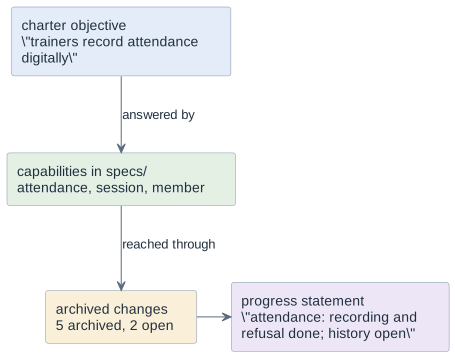
The statement at the bottom is longer than "60 %" and worth more than any number, for three reasons: it names what is done rather than how much, it is falsifiable — run the scenario — and it is written in the client’s vocabulary rather than the team’s.
The honest form of a progress report in this course is therefore a table:
| Charter objective | Capabilities done / total | What is missing |
|---|---|---|
Trainers record attendance digitally |
2 / 3 |
the history view; the spec exists, no change is open yet |
Members see their own bookings |
0 / 2 |
not started; depends on authentication, which is an open question |
The club exports a monthly list |
1 / 1 |
done, archived 2026-11-14 |
Note that the third column carries the reason, and that one row admits a dependency on an unresolved question. A report with no such row is usually a report nobody looked hard at.
Rhythm, and what it predicts
The commit history says something the archive does not: how the work happened.
| What the history shows | What it predicts |
|---|---|
steady commits across weeks, several authors |
the team can absorb a surprise in April |
nothing for three weeks, then forty commits |
the next quiet stretch is also three weeks, and it will land in April |
one author for 90 % of the work |
a single point of failure, and a defence in June that only one person can give |
all commits after 22:00 in the last three days before a review |
the review is being prepared for, not passed |
None of these is a rule about character. They are patterns with a predictive value, which is the only reason to look at them: a milestone review is supposed to say something about the rest of the project, not just about the part already behind you.
The useful question to a team with a bursty history is not "why did you not work in November?" but "what will you do differently so that February is not November?"
What the repository cannot show
Being honest about the limits is what keeps the measure trustworthy.
-
Effort. Two hours of thinking that prevented a wrong design leave no trace, and a hundred commits of formatting leave a lot.
-
Understanding. A team can archive changes an agent produced and not be able to explain them. This is a real risk of the way this course works, and it is why the oral exam exists.
-
Difficulty. An archived change does not say whether it was trivial or took three attempts.
-
Contribution beyond commits. Whoever ran the interviews, drew the model on a whiteboard or unblocked somebody else appears nowhere.
Two of those are covered by the milestone conversation — the reviewers ask, and the answer either comes or does not. Contribution is covered by making the non-code work into artefacts too: the interview protocol, the assumption list and the review findings are committed, and then they count.
Responsibility per person, without a separate report
The charter names who is responsible for what. The record shows it, if the work was done in the normal way:
-
commits and their authors;
-
pull requests: who opened, who reviewed, who merged;
-
the change folder: who wrote the proposal, who wrote the tasks;
-
review findings written by that person into another team’s repository.
That is enough for a defensible statement about an individual, and it costs no extra paperwork — which is the point. A separate contribution report is written at the end, from memory, by whoever is most motivated to look good.
| A record showing one author for everything is a finding about the team, not only about the quiet members. Reviewing each other’s pull requests is the cheapest available fix, and it has to start early enough to be visible. |
Decisions
-
Progress is reported as capabilities done per charter objective, never as a percentage.
-
An unarchived change counts as not done. There is no partial credit for in-flight work.
-
The progress table names, for every incomplete objective, what is missing and why.
-
Individual responsibility is read from commits, pull requests and change authorship. No separate contribution report is written.
-
Non-code work — interviews, decisions, review findings — is committed, so that it can count.
-
A team whose history shows a single author is asked to distribute reviews, and it is checked at the next milestone.
Pitfalls
-
Reporting a percentage. It cannot be checked and it is wrong in a predictable direction.
-
Counting open changes as progress. They are intentions, and intentions are free.
-
Reading the commit count as effort. Formatting commits are cheap and thinking is invisible.
-
Hiding a dependency on an open question. It does not go away, and it surfaces when it is most expensive.
-
Leaving non-code work uncommitted and then complaining that it does not count.
-
Treating a one-author history as a personal problem of the others. It is a team problem with a team fix.
Terminology
| Deutsch | English |
|---|---|
Fortschritt |
progress |
Fertigstellungsgrad |
percentage complete |
Meilenstein |
milestone |
Nachweis |
evidence |
Arbeitsrhythmus |
working rhythm |
Beitrag, Eigenleistung |
contribution |
Abhängigkeit |
dependency |
Further reading
-
Module
sdd-change-lifecycle— the states behind the count -
Module
review-milestone-1— the session in which this reading is done -
Module
bridge-charter-to-specs— where the objectives come from