What is a harness, and which of its parts can you change?
covers: lo-1
Answer
A harness is the program around the model: it assembles the input, calls the model, and acts on the answer. Four parts matter, and three of them are yours.
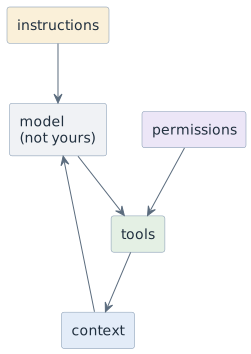
The practical consequence is the whole point of the lesson: two people with the same model and the same task get very different results, and the difference is never the model. One of them shaped the instructions, the context and the permissions; the other typed harder.
Points the answer must contain:
-
Harness = everything around the model: instructions, context, tools, permissions
-
The model is fixed; the other three are yours to shape
-
Result quality is mostly a property of the harness, not of the model
What belongs in a project instruction file, and what does not?
covers: lo-2
Answer
The instruction file is prepended to every session, so it must hold the rules that would otherwise be repeated in every prompt — and nothing else.
A useful instruction has two properties. It is checkable: afterwards you can tell whether it was followed. And it changes an action: something happens differently because of it.
| Belongs in it | Does not |
|---|---|
"Build with |
"This project is a booking system." — that is the README |
"Never commit to |
"Write good code." — nothing follows from it |
"Tests live next to the class, named |
A copy of the coding standard — link it |
Length matters for a reason from the previous lesson: the file is read in full, every turn, and competes for context with the actual question. Two hundred lines of description crowd out the thing you asked.
Points the answer must contain:
-
Standing rules that would otherwise be repeated in every prompt
-
Checkable and action-changing; "write good code" is neither
-
Not project description, not a stale copy of a standard
-
Short, because it costs context in every single session
How do you decide which commands an agent may run without asking?
covers: lo-3
Answer
By reversibility. The question is not how useful the command is but how expensive the mistake is, which gives three tiers:
-
allowed without asking — read-only or trivially undone: reading files, searching,
git status,git diff, running the tests; -
asks first — changes something that matters: editing files,
git commit, installing a dependency, writing outside the project; -
never — irreversible or reaching other people:
git push --force,rm -rf, deleting branches, sending data anywhere.
A mistake you can undo with git restore costs a minute; one that has already
left your machine cannot be undone at all — other people have it.
Two things people get wrong. Approving a command once in a session is not the same as granting it permanently in the settings file. And allowing everything because the prompts are annoying is itself a decision — the better fix is to allow the read-only commands explicitly, which removes most prompts and costs no safety.
Points the answer must contain:
-
Reversibility decides the tier, not usefulness
-
Three tiers with examples; read-only free, changes ask, irreversible never
-
A one-off approval is not a standing permission
-
Blanket approval is a decision, and the wrong one
A result is wrong. How do you tell whether the model or the harness failed?
covers: lo-4
Answer
By the symptom. Each part of the harness fails in a recognisable way:
| Symptom | Cause |
|---|---|
invented a method that does not exist |
model — verify, do not argue |
wrong build command, wrong folder, wrong style |
instructions — rule missing or unfollowable |
answered about a file it never opened |
context — it did not have what it needed |
stopped and asked instead of acting |
permissions — not allowed |
did the right thing and destroyed something else |
permissions — tier too generous |
Only the first line is the model’s, and it is the only one you cannot repair. The other four are yours — which is the useful half of the news, because a repair to the harness holds for the whole team and for every future session, while arguing with the model in one chat helps nobody tomorrow.
The diagnostic habit worth building: when you catch yourself giving the same correction a second time, stop correcting and write it down instead.
Points the answer must contain:
-
Match the symptom to the box: model, instructions, context, permissions
-
Invented APIs are the model’s; wrong conventions are the instructions'
-
Only the model failure is unrepairable; the rest are yours
-
A correction given twice belongs in a file
Why is the harness kept in version control, and what must never be in it?
covers: lo-5
Answer
Because it decides how the whole team works, and because it is a change like any other. An instruction that lives on one laptop helps one person; committed, it helps everybody including whoever joins in February. Reviewing it in a pull request means a change to how four people work gets the same scrutiny as a change to the code.
Never in it: credentials of any kind, and personal data. The file is read by a model and it is in the repository — an API key in it is a published API key, and that is true the moment it is pushed, not when somebody notices.
The corollary about maintenance: when an instruction turns out to be wrong, fix the file instead of working around it in prompts. A workaround repeated four times is a rule that has not been written yet.
Points the answer must contain:
-
Committed and reviewed, because it governs the whole team
-
Version control also makes harness changes visible and revertible
-
No credentials, no personal data — the file is public and machine-read
-
Fix the file rather than repeating a workaround
You keep telling the agent the same thing every session. What do you do?
covers: lo-2, lo-5
Answer
Write it down — but the place depends on what kind of thing it is.
A standing rule that applies to all work ("never commit to `main`", "tests are named `*Test.java`") goes in the instruction file. It is short, it is checkable, and it is needed in every session anyway.
A procedure that applies only in a particular situation — how a release is made, what a bug report must contain, how a module is reviewed — does not belong there. It would be carried through every unrelated session for nothing. It goes in its own file and is invoked when that situation arises.
The distinction is the same one as between a coding standard and a checklist: one is always in force, the other is used at a moment. Getting it wrong in the convenient direction — putting everything in the instruction file — is exactly how that file grows until it crowds out the question you asked.
Points the answer must contain:
-
Repetition is a signal that something is missing from the repository
-
Standing rule → instruction file; situational procedure → its own file
-
The instruction file costs context in every session, so it stays short
-
Committed, so the rule holds for the team and not just for you