What belongs in the context for a task, and what only adds noise?
covers: lo-1
Answer
An agent knows exactly what is in front of it: your instructions, the files it read, the output of the commands it ran. Nothing else — not your repository as a whole, not last week’s session.
| Worth including | Usually noise |
|---|---|
the spec or requirement being implemented |
the entire repository |
the file being changed and its immediate neighbours |
generated output, lock files, build logs |
the exact error message and stack trace |
"it doesn’t work" |
the convention to follow, or a file that shows it |
your entire chat history from last week |
Both directions fail, and they fail differently.
Too little context produces confident guesses about your codebase: invented file names, a convention that is not yours, a second implementation of something you already have. The agent cannot know it is guessing.
Too much context buries the relevant part. Forty files do not make the answer better; they make the three that matter harder to weigh, and the answer drifts towards the average of everything it was shown.
So context is assembled deliberately — the spec, the file, the error — rather than dumped. That is a decision you make each time, and it is most of the difference between a good and a useless session.
Points the answer must contain:
-
The spec or requirement, the file being changed and its neighbours, the exact error, the convention to follow
-
Noise: whole repository, generated files, build logs, unrelated history
-
Too little context produces invented conventions; too much buries the relevant part
What happens when the context window fills up?
covers: lo-3
Answer
The window is finite. In a long session the earliest text — usually your original instructions and the decisions taken at the start — is pushed out to make room for what came later.
The symptom is characteristic, and once you know it you recognise it within a minute: the agent starts contradicting a decision you made an hour ago, or reintroduces a bug you already fixed together, or asks about a file it read earlier. It does not announce this; from its side there is no gap, only the text that is still there.
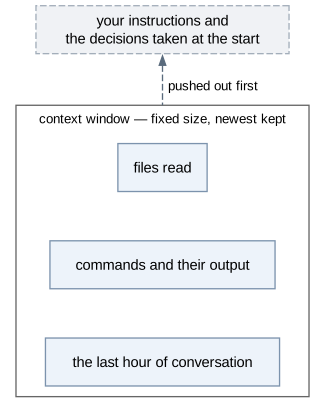
The remedy is not a longer session, and not repeating yourself. It is to end the session deliberately while it is still going well, and start a new one with a written summary — a continuation prompt. A fresh session with three paragraphs of accurate state beats a four-hour session that has forgotten half of them.
Points the answer must contain:
-
Early instructions drop out
-
Symptom: the agent contradicts earlier decisions or reintroduces fixed bugs
-
Remedy: end the session deliberately and restart with a written summary
Which four parts does a continuation prompt have?
covers: lo-2
Answer
State — where things stand, including what is broken. Decisions — what has been settled, so it is not re-litigated. Next — the next step, concretely. Files — where to look.
# Continuation: attendance export

**State:** CSV export works for one session; the date column is off by one
in the DST week (see failing test `ExportTest.dstWeek`).

**Decided:** dates are stored in UTC and converted on export, not the other way
round. Do not "fix" this by storing local time.

**Next:** make `ExportTest.dstWeek` pass, then add the group column.

**Files:** `ExportService.java`, `ExportTest.java`, spec
`openspec/specs/export/spec.md`.
The Decisions part earns its place fastest. Without it, a fresh session proposes storing local time — a reasonable idea that was already considered and rejected — and you spend twenty minutes having the same argument you had yesterday.
Written after every substantial session it costs two minutes and saves a restart.
And note what it really is: exactly the handover a human teammate would need if
they took the work over tomorrow. Writing it for the agent is not extra work; it
is the handover you should have written anyway — which is why the continuation
files of this curriculum repository live under continuations/ in git and not in
a chat.
Points the answer must contain:
-
State, decisions already taken, next step, relevant files
-
Written after each substantial session
-
It is the same handover a human teammate would need
Why does project knowledge belong in the repository and not in a chat?
covers: lo-4
Answer
A chat history has none of the properties that make something a project record. It is not versioned — you cannot see when a decision changed. It is not reviewed — nobody agreed to what is in it. It is not visible to the team — it sits in one person’s account. And it is not searchable next to the thing it describes.
The repository has all four. So anything worth remembering goes into a spec, a
Decisions section, the charter, a continuation file, or a commit message —
places where it is diffed, reviewed and found again by somebody who was not
there.
This is also the honest answer to "but the agent knew this yesterday". It did not know anything. The text was in its window, the window is gone, and a sentence that exists only in a closed session has the same status as a sentence nobody ever wrote down. The corollary is uncomfortable and useful: if a decision is only in the chat, it does not exist for your team either.
Points the answer must contain:
-
A chat is not versioned, not reviewed, not visible to the team
-
"The agent knew this yesterday" is false — the text was in the window and the window is gone
-
Decisions belong in specs,
Decisionssections, charter or commit messages
What is wrong with a continuation note that lists what you did?
covers: lo-2
Answer
It is a diary, and the next reader does not need a diary. They need to continue, which requires two things a list of past activities does not contain: the current state, and the direction.
Compare:
| Diary | Handover |
|---|---|
"Refactored |
"CSV export works; |
The left column takes longer to read and leaves every question open: does it work now, what was decided, what comes next?
The decisions matter most, because they are the part that gets re-litigated otherwise. A rejected alternative that is not written down comes back as a fresh proposal — from a new session, from a teammate, or from you in two weeks — and the work of deciding it is done a second time.
Points the answer must contain:
-
The next reader needs state and direction, not a diary
-
The decisions matter so they are not re-litigated