Learning outcomes
What this chapter is about
Two rockets, both on the pad, both apparently ready. What separates them is underground, where nobody looks until something has to be changed.
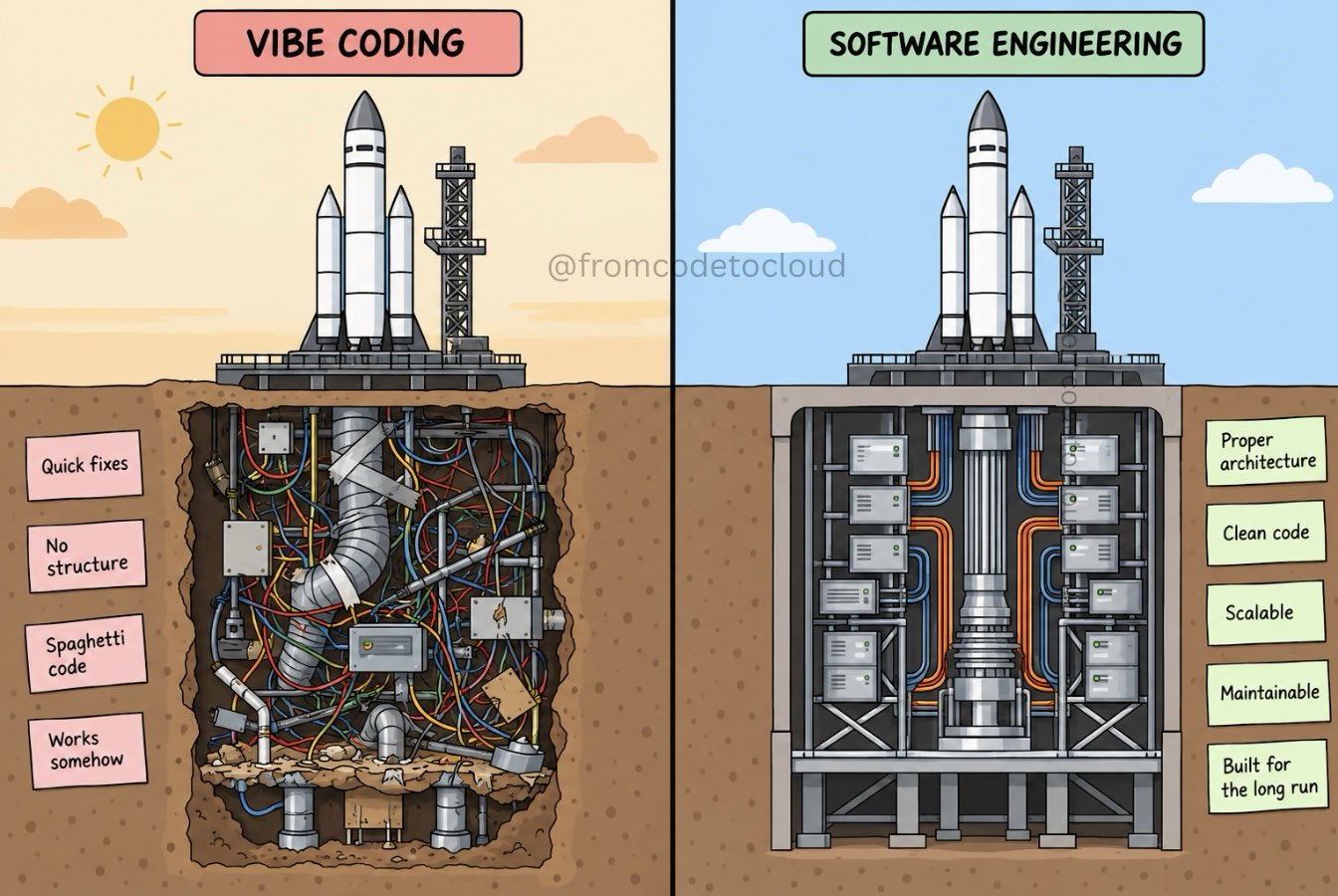
An agent will build you the left-hand side quickly and cheerfully. It works — until the second feature, the first bug report, the first classmate who has to read it. The right-hand side takes the same agent and the same afternoon; the difference is that somebody stated what was to be built, checked what came back and kept the result in a shape the next change can land in.
That is the whole point of the chapter. You are not learning to type prompts. You are learning to stay the engineer while a very fast, very confident apprentice does the typing.
What the thing actually does
A language model predicts likely continuations of text. Everything else — the apparent understanding, the plan, the apology — is a consequence of that. Two practical implications:
-
It has no source of truth. It produces what is plausible, which is usually also correct, and when it is not, it is equally fluent.
-
It has no memory between sessions beyond what you give it. Every session starts from the text in front of it.
An agent is a model plus tools: it can read your files, run commands and edit code. That makes it useful and raises the stakes, because now a wrong prediction changes your repository.
Formulating a task
The difference between a useful and a useless answer is almost always in the question.
| Weak | Better |
|---|---|
"Write a booking system." |
"Add a method |
"Fix the bug." |
"`GET /sessions` returns 500 when the group has no members. Stack trace below. Fix the cause, not the symptom, and add a test for the empty case." |
"Is this good code?" |
"Review this file for cases where a null list would crash it. List each with the line number." |
Three ingredients: what must be true afterwards, where it belongs in the existing code, and how you will check. The third one is the one people leave out, and it is the one that turns a plausible answer into a verified one.
Failure modes worth expecting
| Failure | What it looks like |
|---|---|
Confident wrongness |
a clean, well-argued answer that is simply false; no hedging, no signal |
Invented interfaces |
a method that does not exist, with an entirely plausible name |
Outdated practice |
patterns from older versions of a framework, presented as current |
Silent scope creep |
it also "improves" four other files you did not ask about |
Agreeing with you |
you push back on a correct answer and it folds |
The countermeasure is not distrust, it is verification: run it, test it, read the diff. You would not merge a classmate’s pull request unread either.
What you may and may not hand over
-
May: code in your own repository, public documentation, your own text, generated test data.
-
Must not: personal data of other people — names, marks, addresses, attendance records of real members. Anything under the school’s data protection rules stays out of a prompt.
-
Careful: credentials and tokens. They belong in neither prompts nor repositories.
Decisions
-
Agents are used openly in this course. Hiding their use is not the concern; being unable to explain the result is.
-
You are responsible for what you commit, regardless of who or what wrote it.
-
No personal data in prompts.
-
Every agent result is verified before it is committed — run, test, read.
Pitfalls
-
Committing a diff you have not read. The oral exam finds out, and so does the build.
-
Asking for the whole feature in one prompt. Large answers hide their mistakes; small steps expose them.
-
Taking the first answer. A second attempt with a sharper question is usually much better than an argument with the first one.
-
Believing that a confident tone means a checked answer. There is no correlation.
Terminology
| Deutsch | English |
|---|---|
Sprachmodell |
language model |
Eingabeaufforderung |
prompt |
Halluzination |
hallucination, confident wrongness |
Nachvollziehbarkeit |
traceability |
personenbezogene Daten |
personal data |
Further reading
-
Module
ai-context-continuation— giving the agent the context it lacks -
Module
ai-result-verification— checking what came back, systematically