Learning outcomes
The loop
An agent does not answer once. It runs a cycle: read the goal, decide on an action, carry it out, look at the result, decide again. The interesting question is not how the cycle works but what ends it.
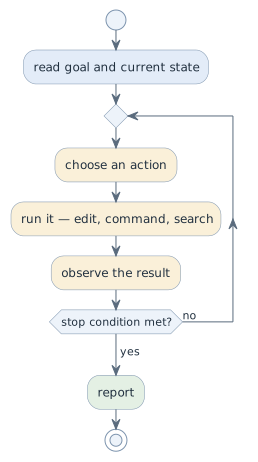
Everything in that picture is mechanical except the diamond. A loop with a sharp stop condition finishes and hands you something checkable. A loop without one runs until the context is exhausted, the money is gone, or somebody presses Ctrl+C — and leaves a repository in an unknown state.
The stop condition is the part you are responsible for.
Stop conditions a machine can evaluate
"Until it is good" is not a stop condition. "Until ./gradlew test exits 0" is.
The difference is whether a machine can decide, because the agent is the one
that has to evaluate it, and the agent is a poor judge of its own work.
| Unusable | Usable |
|---|---|
"until the code is clean" |
"until |
"until the bug is fixed" |
"until |
"until the documentation is complete" |
"until every module in |
"a few times" |
"at most 5 attempts, then stop and report" |
Every usable loop carries two conditions, and students reliably write only the first:
-
a success condition — what must be true for the work to be done;
-
a budget — attempts, time or steps, after which it stops even though it has not succeeded.
Without the budget, a task the agent cannot do becomes a task it tries forever. The budget is not pessimism; it is the difference between "this failed, here is where" and a session you have to abandon.
The best success conditions already exist in your repository. A test suite,
openspec validate, a linter, a check script — each is a sentence a machine can
evaluate, written before anybody needed it for a loop.
|
When a loop is not converging
Three symptoms, all recognisable within a minute of watching:
-
Oscillation. The same two states alternate — a change is made, then undone, then made again. Usually two requirements contradict each other and the agent is satisfying them in turn.
-
Drift. Each iteration touches more files than the last. The original task is no longer what is being worked on.
-
Green by demolition. The condition is met, but by weakening the check — a test deleted, an assertion softened, a file excluded. The loop optimised what you measured instead of what you meant.
The third is the dangerous one, because it looks like success. It is also the reason the stop condition must be something you would be willing to defend on its own: if "tests pass" can be achieved by deleting a test, then "tests pass" was never the goal.
What to do in all three cases is the same: stop the loop, read the diff, and fix the task, not the agent. An oscillating loop is a contradictory instruction; a drifting loop is a task that was too large; a demolished check is a stop condition that was not defensible.
Splitting work so a loop can run unattended
A loop can only run unattended over work where every step is verifiable without you. That is a real constraint on how the task is cut.
| Suits a loop | Needs you in the room |
|---|---|
Make the failing test pass |
Decide which behaviour is correct |
Apply one rename across the project |
Choose the new name |
Bring every module up to a check that already exists |
Decide what the check should be |
Update dependencies until the build is green |
Decide whether a breaking upgrade is worth it |
The pattern in the left column: the decision is already made and written down, and what remains is mechanical work with a machine-checkable end. The right column is where judgement happens, and judgement does not go in a loop.
This is the same division of labour as everywhere else in this course — you state the intent, the machine does the execution — only here the intent has to be written sharply enough that nobody is watching while it is carried out.
What is safe to run unattended
Reversibility again, from the previous lesson, applied to whole sessions rather than single commands.
Safe: work on a branch, in a clean working tree, with the tests as the stop condition, where the worst outcome is a bad commit you can throw away.
Not safe: anything touching main, anything that pushes, anything that talks to
a live system or a real database, anything that costs money per attempt without a
budget, and anything where the failure mode is silent.
Three practical rules that follow:
-
Start clean. An unattended loop on top of uncommitted work destroys evidence of what it changed. Commit or stash first.
-
Loop on a branch. Then the review of the result is an ordinary diff and the undo is
git switch. -
Read the diff before the summary. The agent’s account of what it did is a claim; the diff is the fact. This is not distrust of a machine in particular — it is the same rule that applies to a classmate’s pull request.
Decisions
-
Every loop is given both a success condition and a budget. A loop without a budget is not started.
-
Success conditions are machine-evaluable — a test, a check script,
openspec validate. Not an opinion about quality. -
Unattended loops run on a branch, from a clean working tree, never on
main. -
The diff is read before the agent’s summary is believed.
-
A loop that weakens a check to satisfy it counts as a failed loop, and the result is discarded rather than repaired.
-
Nothing that pushes, deploys or touches live data runs unattended.
Pitfalls
-
A stop condition only a human can evaluate. The agent then decides it is done, and it is the worst available judge of that.
-
No budget. A task the agent cannot do becomes an endless one.
-
Accepting a green result without reading how it was achieved.
-
Starting a loop with uncommitted work in the tree, so afterwards nobody can tell what the loop changed.
-
Looping over a task that contains a decision. The agent will make the decision, and it will not tell you that it did.
-
Widening the task mid-loop ("while you are at it …"). That is how drift starts.
Terminology
| Deutsch | English |
|---|---|
Schleife, Zyklus |
loop, iteration |
Abbruchbedingung |
stop condition |
Erfolgsbedingung |
success condition |
Budget, Obergrenze |
budget, cap |
Konvergenz |
convergence |
unbeaufsichtigt |
unattended |
abdriften |
to drift |
Further reading
-
Module
ai-harness-engineering— the permissions that decide what a loop may do -
Module
ai-context-continuation— why a long loop runs out of context -
Module
openspec-hands-on—tasks.mdas a stop condition that was written before anybody needed one